Category Archives: Transportation

MTR Island Line Extension Set to Change Hong Kong’s Western District

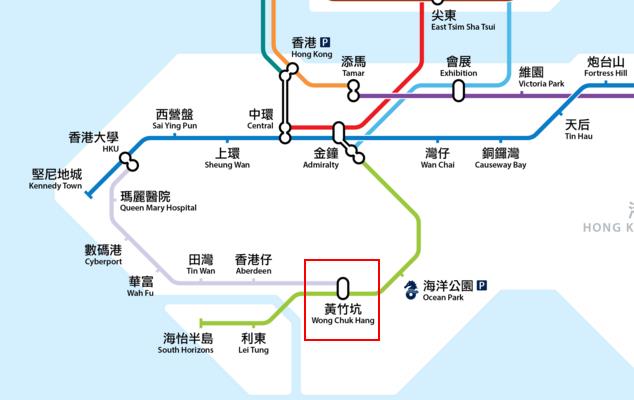
Blue Dot = Current Western Extent of MTR Hong Kong Island Line (Sheung Wan)       Red Dot = Terminus of Island Line Western Extension To Open in 2014 (Kennedy Town)

Infrastructure development continues in Hong Kong as the city’s Metro Transit Railway (MTR) extends its underground Island Line into the city’s Western District. Beginning construction in 2009, the western extension of the Island Line (dubbed the ‘West Island Line’) is set to open in 2014. The Island Line currently ends at Sheung Wan, one stop west of Central (Hong Kong’s central business district), but the extension will add three new stops, including Sai Ying Pun, Hong Kong University, and terminating at Kennedy Town.

MTR Station Under Construction On Pok Fu Lam Rd. Across from Hong Kong University

The West Island Line is unique because of uphill/downhill conditions at the Sai Ying Pun and Hong Kong University Stations. At both stations, MTR plans show station exits at various elevations, with high-speed vertical lifts transporting passengers from deep within the subway tunnel up to the Mid-Levels area (see this link for clear sectional diagrams of how this works). The Sai Ying Pun Staiton will have exits at three different elevations: Queen’s Road West, First St./Second St., and Bonham Road.

The extension will also be huge boon for students who commute to HKU. The university’s campus, situated on a steep hill and not easily accessible as a pedestrian, will be served by an exit directly across from the entrance at Pok Fu Lam Road.

The Island Line Western Extension Will Benefit Students Who Commute to HKU

The Belcher’s, a High-Rise Residential Development in the Western District

Because Hong Kong’s Western District is not well served by public transport, rents and property prices have traditionally been lower than other parts of the island with better access to the MTR. Aside from the Belcher’s, a high-rise residential development completed in 2001 that sits atop a shopping mall, the Western District still retains a marked ‘mom and pop’ low-key atmosphere.

It is hard to predict how this will change in 2014 when the West Island Line opens. Property developers  real estate investors have already taken note, but with most of the area already built up with an aging housing stock, there is not much new open space for development.

Whatever future changes come to the neighborhood though, the MTR extension is a positive development for Hong Kong as it continues to serve as  a model of public transportation efficiency for cities around the world.

Kennedy Town. MTR Construction in the Background

24 City Rises in Southeast Chengdu

The sound of new development roars all over Chengdu. One area that is particularly on the uptick is the southeast, just outside the 2nd Ring Road. Not long ago a heavy industrial zone, several former factory sites were cleared to make way for new high-density residential, retail and office development.

Today the area is a gigantic series of noisy, dusty construction sites. Not only is abundant new real estate floor space being built, but the area is making way for two upcoming metro lines: line 2 and line 4. Though only 4.5 km from the city center, the area feels worlds away from the city’s historic core. Yet as Chengdu continues to sprawl out, the new development is bound to become part of the urban area within a few years.

24 City is 4.5 km south-east of Chengdu’s city center (highlighted in purple)

One of the large new developments in this area is 24 City, spanning several blocks with a new shopping mall, office and residential towers. The shopping mall and office tower are designed by American architecture firm Callison and is rounding out construction.

Callison-designed terraced shopping mall

A new office tower rises out of the shopping mall podium

The retail podium topped out with office tower is the standard formula for commercial mixed-use developments across Chengdu (and China). The almost complete buildings are only Phase I, which is planned to be followed by several more phases of retail podium + towers on top.

Across the street from the shopping mall are two new residential compounds with clusters of dozens of tall buildings. A quick peek into one of the sales centers confirmed that the new units have no problem being sold off. Whether intended as speculative investments or primary residences, the investments are bound to payoff as the proximity to the planned subway stops means that this will soon be a convenient area for moving around the city by public transit.

Unfortunately the design of the residential compounds leave much to be desired. On one side, a row of regimented towers lines the adjacent public street, creating an ominous canyon of darkness. The inside of the compound is a much more pleasant environment, with well-kept landscaped grounds punctuated with water features.

Tragically, these areas of respite lay behind electric fences and are for residents only. So, despite giving off the image of ‘real’ urbanism (dense clusters of high-rise towers), theses developments are no different from the gated communities of sprawling American suburbia. In the end, 24 City is unremarkable in that it follows the same pattern of brand-new development being followed in countless other Chinese cities without breaking any new ground.

Guangzhou’s New Central Business District: Zhujiang New Town

Guangzhou’s New CBD (highlighted in red) sits north of the Pearl River and east of the Old City in what not long ago was agricultural land

Recently I visited Zhujiang New Town, Guangzhou’s newly built central business district (CBD). While Guangzhou itself is hardly a new city (its status as an international trading port goes back centuries), the CBD is brand new, built on what used to be agricultural land well outside of the historic city core. Though thanks to the city’s expanding underground metro and freeway system, Zhujiang New Town doesn’t seem so far away.

Currently Zhujiang New Town is best known as the site for the Guangzhou Opera House and many of the athletic venues for the 2010 Asian Games. One unique aspect about Guangzhou’s CBD compared with others around China is its marriage of cultural buildings with commercial office towers. In this regard, Zhujiang New Town is not much different from the planned ‘downtowns’ of sprawling 20th Century American cities like Los Angeles, Phoenix and Houston.

The iconic Canton Tower sits across the river, just south of the new CBD

View looking north at towers going up in the CBD

Aerial map of Guangzhou CBD

Adjacent to the Pearl River to the north is the site of Zhujiang New Town’s new cultural venues linked by a paved plaza. Directly north of that begins a park stretching four long blocks lined with brand new office towers. Underneath the park, a metro line runs the length of the CBD. This particular line of the Guangzhou metro system has no driver (so far this is the only instance of this I’ve seen in China!).

While the cultural venues were bustling with life when I was there, many of the completed office buildings were for the most part unoccupied and the park was a no-man’s land. This is not to say that the towers won’t be occupied very soon, as the finishing touches were just being put on. It will be interesting to see how this sparkling new CBD fills itself up in the coming months and years ahead.

1. Guangzhou Opera House

2. Guangdong Museum

3. Guangzhou Library

4. IFC Tower

5. New Commercial Office Buildings

6. Agricultural Bank of China Building

7. The Pearl River Tower

8. More Commercial Office Towers Under Construction

Speculation: China’s Proposed Eco-Cities

A piece I wrote about China’s proposed eco-cities appeared recently in the  inaugural issue of Dwell Asia magazine. The article takes a look at two proposed eco-cities, Dongtan in Shanghai and the Sino-Singapore Eco-city in Tianjin, examining the implications of the ideas presented in both proposals.

For the readers of the China Urban Development Blog, here is a reproduction of the original piece:

Today’s urban development zeitgeist suggests that cities should move towards sustainable models of living to combat climate change and reduce resource consumption. Of course, how to achieve that is a subject of ongoing debate among design and planning professionals. Unfortunately, branding new developments as ‘green’, ‘eco’ or ‘sustainable’ is often a loaded attempt to satisfy marketing and public relations needs for developers and government officials.

Nowhere is the use of greenwashing strategies more common than in China, where new cities practically arise overnight. Many new developments, particularly large-scale residential communities consisting of repetitive tower blocks, with names like Authentic Gardens and Spring Flower Court, claim to be environmentally friendly, but have little in the way of sustainable design strategies aside from a few patches of green space.

There are few problems with this mode of development. For one, new residential projects often take up entire city blocks, turning their back on public streets and discouraging a mix of uses and walkability. Secondly, tower blocks are often built cheaply without proper insulation or sealed windows, leading to more energy consumption for heating and cooling. With the demand for new residential units so strong, there is generally no incentive for property developers to spend extra on things that would save energy in the long run.

The need to make new residential developments sound greener than they actually are reflects a deep contradiction between China’s traditional love of nature and its current state of hyper-urbanisation. As more farmland makes way for expanding cities, promoting a sense of nostalgia ensures that newly developed properties will appeal to first time Chinese homebuyers. Yet a new mode of development is emerging in what might ultimately serve as more appropriate and honest model for China to reconcile its agrarian past with its
urban future.

Enter the eco-city. The eco-city concept, which has gained a wide international audience among planners and environmentalists over the last two decades, aims to build new cities and neighbourhoods in a way that uses the best of sustainable technologies and planning strategies to reduce waste and carbon emissions. Given its current state of development, China is an ideal testing ground for new eco-cities.

Dongtan: A planned Eco-city on Chongming Island in Shanghai

China is lauded for two planned eco-cities in particular: Dongtan, on Chongming Island in Shanghai, and the Sino-Singapore Eco-city in Tianjin. Both eco-cities lie well outside the traditional urban cores of their respective municipalities and seek to become self-sufficient sustainable communities complete with residential, commercial, retail, educational and recreational uses. The way in which these eco-cities differ from other new developments around China is their focus on clean energy, including solar, wind and bio-fuels and urban design promoting sustainable transportation methods such as walking and cycling.

Despite the good intentions of their designers, there is some concern over the viability and appeal of such developments. Some critics argue that Dongtan, which is now indefinitely on hold, is nothing more than a ‘Potemkin Village’ meant to make government officials look good. Others argue that the high initial cost of sustainable technologies means that the cost of living will be too far out of reach for middle-class Chinese urbanites.

Perhaps most misleading about China’s eco-cities is the overall impact they will have on the entire country’s carbon footprint. Together, Dongtan and the Tianjin Eco-City are planned for less than 1 million residents…a drop in the bucket compared to an urbanising population of more than a billion.

Sino-Singapore Eco-city in Tianjin

Eco-city hype aside, China is doing much more to develop towards a more sustainable future in ways that will have much greater impact. Construction of transportation infrastructure, including a national high-speed rail system and extensive metro systems in nearly every large city, will help reduce carbon emissions. Furthermore, China is already the world leader in renewable energy technology, with enormous investment into wind and solar energy.

Whether or not China’s eco-cities ever come to fruition, there are lessons to be taken from the ideas presented in the plans. Promoting genuine mixed-use neighborhoods and buildings with sustainable technologies such as passive heating and cooling and low-flush toilets are a step in the right direction. Yet given the type of development that is currently en vogue in China (the quickly built, tower block type), perhaps it best to start with the unglamorous basics: wall insulation and properly sealed windows.

High-Speed Train Derails in Zhejiang Province

In a gigantic blow to the credibility and safety of China’s high-speed rail network, a train traveling from Zhejiang’s provincial capital of Hangzhou to the seaside city of Wenzhou derailed Saturday evening. Details at this point are still developing, but so far reports have said that the train was struck by lightning and then subsequently hit by another train, leading to two of the train’s cars falling from a bridge. So far, 16 passengers are reported dead and 89 injured.

Having ridden on several of China’s new high-speed trains myself makes seeing the wreckage of this accident all that much more surreal. Whether the accident is due to some sort of track or train defect is yet to be determined. If the train was in fact struck by lightning, this could turn out to be a freak accident. If not, then surely there will be further inquiry into the quality of the fly ash which acts as a critical component of the track foundation mixture.

Whatever the cause of the crash, this incident marks a turning point in China’s high-speed rail program. From now on, questions about safety compromises are bound to come to the forefront of the discussion.

I will keep you posted with updates as more information becomes available.

UPDATE:

The death toll is now up to 35, with 210 more injured. It turns out that lighting did strike the first train, D3115 en route from Hangzhou to Fuzhou, causing the train to lose power and come to a stop. Shortly after, D3115 was struck from behind by another train, D301 en route from Beijing to Fuzhou. The crashed caused the first four cars of D301 to derail and fall 20 meters off the viaduct.

Rescue efforts are encouraging, with bystanders and uninjured passengers having offered up immediate assistance before rescue crews arrived at the scene. Hundreds of Wenzhou residents have also donated blood to local hospitals ensuring that blood supply is sufficient for injured passengers.

Whenever tragic transportation accidents happen at this scale, people are quick to assign blame. Already many commentators are pointing to the alleged shoddy quality of the tracks as a reason for this accident. Some even go further suggesting that this is a result of a Chinese culture that doesn’t value quality or safety, pointing to the rampant corruption and food scandals.

At this point it seems that the accident was not a result of shoddy tracks but a miscommunication problem. As soon as train D3115 came to a stop, train D301 and all other trains on that line going in the same direction should’ve been alerted. It’s possible that the lighting strike, which caused D3115 to lose power, also caused it to fall off radar.

Whatever the ultimate cause of the crash, the incident is bound to add fire to the critical voices of high-speed rail development in China.