View from the Ground in the Chengdu-Chongqing Economic Zone

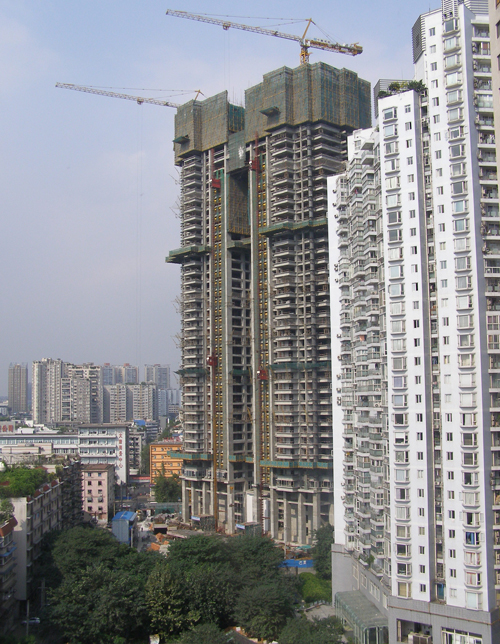
New development outside Jiangyou, Sichuan Province

The following post is an adaptation of a comment I made on my good friend and Chengdu-based American writer Sascha Matuszak’s recent ChengduLiving article about the development of the Chengdu-Chongqing Economic Zone. The comment recalls my own experience of a business trip to one of the smaller cities in the zone: Jiangyou, Sichuan Province:

Thanks for the update on the Chengdu-Chongqing Economic Zone, Sascha. Having been to several of the 3rd and 4th tier cities in Sichuan you mentioned (Suining, Mianyang, Nanchong, etc..) I’ve often wondered how the prosperity in the region’s two dominant cities (Chengdu and Chongqing) would trickle into these other cities as well.

It seems as if most of the young ambitious Chinese people I meet from these cities who now live in Chengdu feel like there is nothing left for them in their hometowns. They also tell me that if they want to move ahead the best opportunities are found in Chengdu or Chongqing.

This isn’t to suggest that Chengdu and Chongqing will continue being the only cities absorbing all the region’s young, educated and ambitious talents. As is clear from what you wrote, the government is pushing for the prosperity to spread throughout the region. And given the enormous combined population of Sichuan Province/Chongqing Municipality at a whopping 110 million people, this is certainly a reasonable plan.

Unfortunately, observations on the ground often tell a different story. About a year and a half ago I was in a city called Jiangyou (famous as the hometown of the poet Li Bai and now actually considered a part of greater Mianyang) to meet with a housing developer for a potential new project. The developer had just finished building a series of faux Italian-style villas on the outskirts of town and reveled in showing us the finished product. No one had moved in yet, but the units were sold out. Continue reading
China Surges Ahead While Ideological Battles Hinder the U.S.

Public policy, stripped to its basics, is a choice among value alternatives. What one person will vehemently contend is the correct policy and another will say is wrongheaded will not depend on empirical measurement, but on the person’s values, philosophy, and ideology.” – John Kasarda

While in the above quote Kasarda, business professor at UNC-Chapel Hill and co-author of the book Aerotropolis, refers to individual values, the same rule is also applicable to groups and institutions. This is certainly the case in the United States where the government  is in the midst of tense negotiations over the so-called ‘debt ceiling’. America’s two main political factions, Republicans and Democrats, are currently at a loss of coming to a consensus due to ideological hangups.

Republicans, who favor severe austerity by cutting social programs yet oppose any sort of tax increases, are unwilling to compromise. The Republicans’ flawed ideological-based approach to solving America’s  economic turmoil comes at perhaps one of the worst times in the country’s history with unemployment at an all-time high and millions losing social benefits. Even Vice President Joe Biden recently told Republican lawmakers that their “intransigence over taxes is a matter of ideology not economics“. Continue reading

World’s Longest Sea Bridge Opens in Qingdao

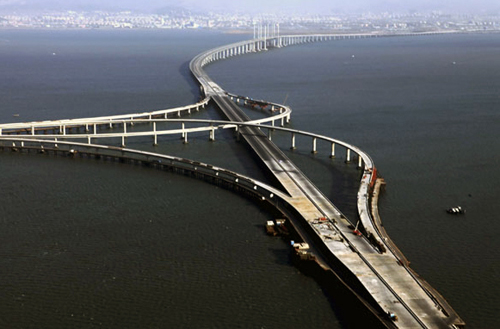
To mark the 90th Anniversary of the founding of the Communist Party two weeks ago, the seaside city of Qingdao in Shandong province opened its new Jiaozhou Bay bridge. At 42.4 km, it is the longest sea bridge in the world. The bridge links historic Qingdao with the city’s industrial zone Huangdao. Continue reading

China’s Ancient Cities and the Crisis of Branding

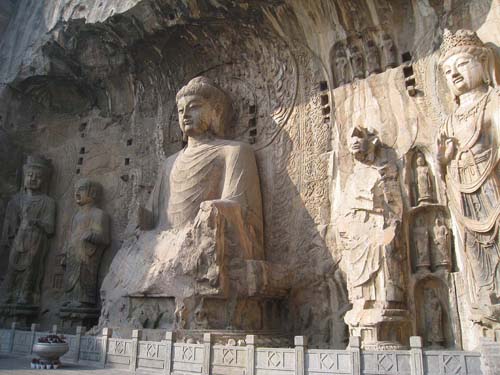
UNESCO Heritage Site, Longmen Grottoes Stone Carvings near Luoyang, Henan Province.  Photo by Easytourchina.

In April I had the honor of being invited to sit on a panel at a conference sponsored by Forbes China in Luoyang. The discussions that took place during the event centered around the next 10 years of development in central China. With Luoyang being the host, much of the discussion pertained to the city itself.

Luoyang, a city of about 6 million people, sits in China’s central plains in the northwestern part of Henan Province, 100 kilometers west of the provincial capital Zhengzhou. New buildings dot the skyline, but not at the high density one sees in 1st or 2nd tier Chinese cities. Automobile and pedestrian traffic is light as well. Wide, tree-lined streets with bike lanes and generous sidewalks lend the city a pleasant atmosphere.

What is not immediately clear traversing the streets of Luoyang is the fact that it is one of China’s Four Great Ancient Capitals. Luoyang was a seat of power for several dynasties- most prominently during the Eastern Zhou and Han dynasties, and later the Sui and Tang dynasties. Continue reading

Fears About a China Housing Crash Overstated

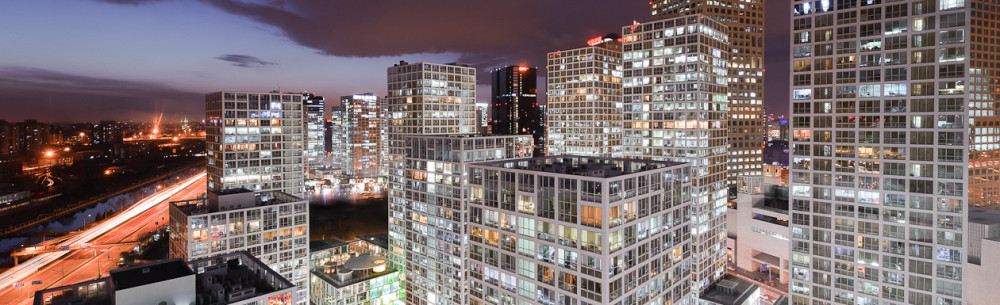
Consensus among international media is that China’s economy is heading for an imminent and disastrous crash due to its inflated housing market. While there is absolutely no denying that housing prices in central parts of 1st Tier cities such as Beijing, Shanghai and Guangzhou are sky-high, this does not signal the end of China’s economic rise. If anything, the high price of housing in these cities affirms China’s rise from poor, cut-off backwater to the world’s second largest economy. Continue reading