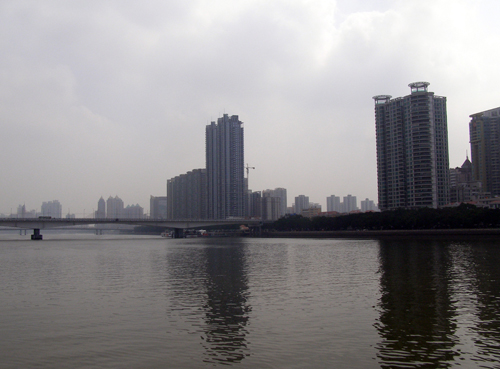
View from the Ground in the Chengdu-Chongqing Economic Zone

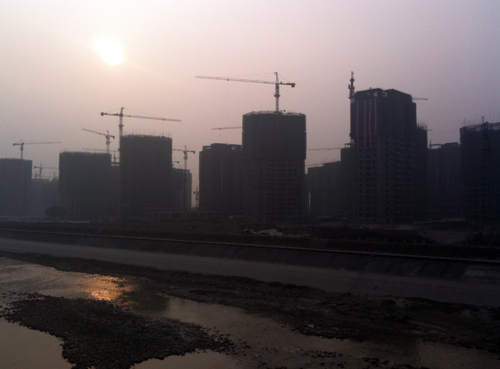
New development outside Jiangyou, Sichuan Province

The following post is an adaptation of a comment I made on my good friend and Chengdu-based American writer Sascha Matuszak’s recent ChengduLiving article about the development of the Chengdu-Chongqing Economic Zone. The comment recalls my own experience of a business trip to one of the smaller cities in the zone: Jiangyou, Sichuan Province:

Thanks for the update on the Chengdu-Chongqing Economic Zone, Sascha. Having been to several of the 3rd and 4th tier cities in Sichuan you mentioned (Suining, Mianyang, Nanchong, etc..) I’ve often wondered how the prosperity in the region’s two dominant cities (Chengdu and Chongqing) would trickle into these other cities as well.

It seems as if most of the young ambitious Chinese people I meet from these cities who now live in Chengdu feel like there is nothing left for them in their hometowns. They also tell me that if they want to move ahead the best opportunities are found in Chengdu or Chongqing.

This isn’t to suggest that Chengdu and Chongqing will continue being the only cities absorbing all the region’s young, educated and ambitious talents. As is clear from what you wrote, the government is pushing for the prosperity to spread throughout the region. And given the enormous combined population of Sichuan Province/Chongqing Municipality at a whopping 110 million people, this is certainly a reasonable plan.

Unfortunately, observations on the ground often tell a different story. About a year and a half ago I was in a city called Jiangyou (famous as the hometown of the poet Li Bai and now actually considered a part of greater Mianyang) to meet with a housing developer for a potential new project. The developer had just finished building a series of faux Italian-style villas on the outskirts of town and reveled in showing us the finished product. No one had moved in yet, but the units were sold out. Continue reading

9/11, China and the Enduring Symbolic Power of the Skyscraper

1 World Trade Center Rising in Lower Manhattan

Now that it has been about a month since the 10 year anniversary of the 9/11 attacks in the U.S., I have had some time to reflect on the enduring significance of the skyscraper. With One World Trade Center finally starting to form a new image in the Manhattan skyline, we see that in spite of protestations to building such a tower on sacred ground, construction crews move ahead to realize what will perhaps be the city’s most ambitious project in years. Some question why it has taken so long to get to this point while others still see the entire rebuilding effort as an affront to the memory of tragedy. Continue reading

China and the Legacy of Steve Jobs

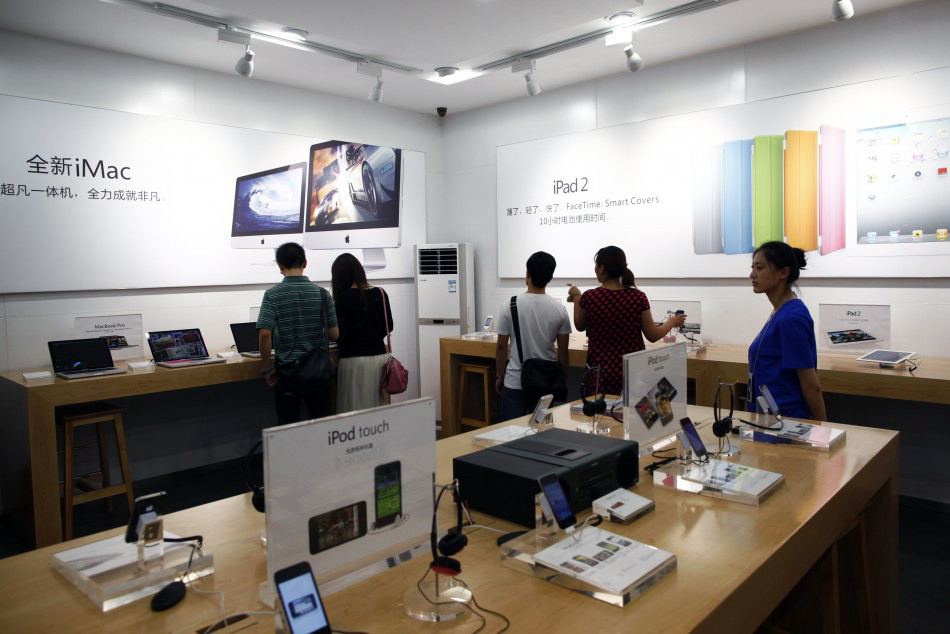
Fake ‘Apple Store’ in Kunming

It is not hard to understate the influence that Apple has had on China. If we examine the role the country plays in the supply-chain of Apple products, then China’s relationship with the company is undeniable. It is safe to say that without China’s contribution to the manufacturing and assembly process, Apple’s stylish products would be unaffordable to the average consumer around the globe.

That’s why last year when a string of suicides hit Foxconn, the company that manufactures products such as the iPad and iPhone, Steve Jobs was quick to announce that Apple would look into the working conditions. Jobs, a marketing genius, knew that negative PR associated with Foxconn would hurt Apple’s sleek and stylish image in the U.S.

What commentators in the U.S. failed to notice is the relative ambivalence of people in China regarding the Foxconn suicides. When I asked my Chinese colleagues what effect the incident had on their perception of Apple, they responded that there was absolutely none. Not only that, they defended Foxconn by saying that the rate of suicides among workers (there are tens of thousands of them) is not abnormal for society at large. Continue reading

China Surges Ahead While Ideological Battles Hinder the U.S.

Public policy, stripped to its basics, is a choice among value alternatives. What one person will vehemently contend is the correct policy and another will say is wrongheaded will not depend on empirical measurement, but on the person’s values, philosophy, and ideology.” – John Kasarda

While in the above quote Kasarda, business professor at UNC-Chapel Hill and co-author of the book Aerotropolis, refers to individual values, the same rule is also applicable to groups and institutions. This is certainly the case in the United States where the government  is in the midst of tense negotiations over the so-called ‘debt ceiling’. America’s two main political factions, Republicans and Democrats, are currently at a loss of coming to a consensus due to ideological hangups.

Republicans, who favor severe austerity by cutting social programs yet oppose any sort of tax increases, are unwilling to compromise. The Republicans’ flawed ideological-based approach to solving America’s  economic turmoil comes at perhaps one of the worst times in the country’s history with unemployment at an all-time high and millions losing social benefits. Even Vice President Joe Biden recently told Republican lawmakers that their “intransigence over taxes is a matter of ideology not economics“. Continue reading

Local Debt Adding Fuel to Bearish Outlook on China

Credit rating agency Moody’s recently released a report claiming that Chinese financial auditors have understated local government debt by half a trillion dollars. This is no small estimate, and the thought of so many non-performing loans on bank balance sheets is enough to make any seasoned investor bearish on China.

Of course, the majority of debt is fueled by lending that is going to local provincial and municipal governments and developers to fund new infrastructure and building projects. Banks are making these loans because of direct orders from the top-level of China’s central government. These orders were stepped up significantly after the 2008 world financial crisis to keep the country’s growth engine humming along as the export market fell off a cliff. Continue reading