
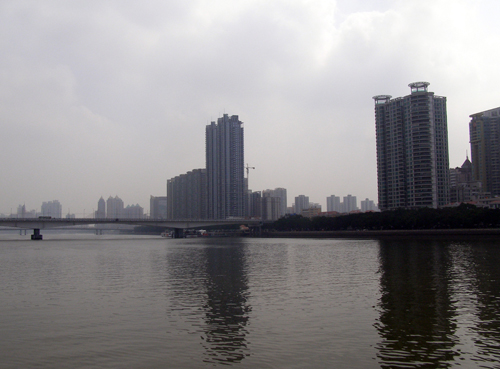
Local Debt Adding Fuel to Bearish Outlook on China

Credit rating agency Moody’s recently released a report claiming that Chinese financial auditors have understated local government debt by half a trillion dollars. This is no small estimate, and the thought of so many non-performing loans on bank balance sheets is enough to make any seasoned investor bearish on China.

Of course, the majority of debt is fueled by lending that is going to local provincial and municipal governments and developers to fund new infrastructure and building projects. Banks are making these loans because of direct orders from the top-level of China’s central government. These orders were stepped up significantly after the 2008 world financial crisis to keep the country’s growth engine humming along as the export market fell off a cliff. Continue reading


China Linking Southeast Asia with High-Speed Rail

Kunming, Yunnan Province:   China’s Gateway to Southeast Asia

China receives a lot of well-deserved recognition for its expanding high-speed passenger rail system. Now China’s rail ambitions are extending well beyond its borders into neighboring countries. This April, construction is to begin on a rail line linking southern Yunnan province with the country of Laos to the south.

With cash in hand and the ability to build such a rail line, China is paying for the majority of the construction cost while Laos will only be responsible for 30% of the cost. This is yet another example of China exercising its policy of ‘infrastructure diplomacy’- that is, helping other developing nations pay for and build new infrastructure to promote favorable relations and gain access to natural resources. Continue reading

Post G-20 Hangover: Trade Wars, Currency Manipulation & More

Downtown Seoul

The G-20 meeting in Seoul earlier this month left in its wake a trail of uncertainty regarding the state of the global economic system. The U.S. received its fair share of criticism over its ‘QE2’ quantitative easing measure. ‘Quantitative easing’ is  essentially akin to the Federal Reserve Bank printing more money. The goal here is to help stimulate job growth in the U.S. by weakening the dollar. Forbes columnist Shaun Rein explains why quantitative easing might actually be  a terrible mistake.

Treasury Secretary Timothy Geithner denies the U.S. is manipulating its currency while continually berating China over the low valuation of its RMB. With QE2, the United States can no longer taker the moral high-ground because it has now entered the currency devaluation game. The intent of QE2 is to try to direct investment and job growth back to the U.S. but it will probably have the opposite effect: lowering the standard of living of American by causing inflation. Continue reading

China, Japan, America

Japanese Retail Chain Uniqlo at Chengdu’s Chunxi Lu Shopping Street

After spending the previous two weeks in the U.S. visiting friends and relatives, I returned to chaos in Chengdu last week. Just a few blocks from my apartment, protests were being held at the city’s main shopping street, Chunxi Lu, against Japanese-owned businesses. I had no idea this was going on until I was alerted by my friends over at Chengdu Living who were there documenting the scene with photos and video.

This anti-Japanese demonstration came about due to a recent dispute about the ownership of the Diaoyu Islands in the Pacific. The cultural rift between the two countries goes deeper than that though, with bitter feelings about Japan’s invasion of China during World War II still prevalent among those living in mainland China. Continue reading

China, America, Paul Krugman

Every few months, Nobel Prize winning economist and New York Times columnist Paul Krugman writes an opinion piece lambasting China for ‘manipulating’ its currency, the renminbi (RMB). Whenever he brings this particular issue up, Krugman argues that China is undermining America’s (and other countries) manufacturing competitiveness.

I have responded to Krugman’s previous commentaries about the Chinese currency issue before (U.S. – China Trade Complications) and discussed why letting the RMB float will not bring manufacturing jobs back to the U.S. Krugman doesn’t seem to be getting the message based on yet another  Op-Ed he penned titled China, Japan, America. Continue reading