Category Archives: Chongqing

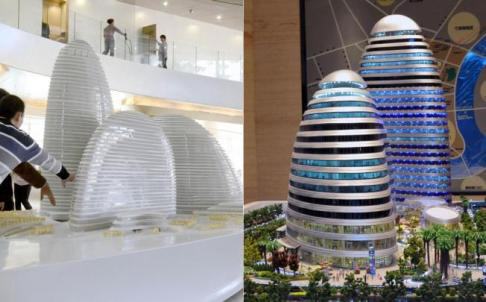
Why is Zaha Hadid being copied in China?

Zaha_copied in ChinaZaha Hadid’s Wangjing SOHO design (left). Chongqing Meiquan 22nd Century design (right). Image from AFP.
Earlier this year, the architecture world was in shock after a story made the rounds that a Zaha Hadid designed project in Beijing is being pirated by a developer in Chongqing. What’s surprising about this story is not the actual copying of Hadid’s design but the reaction from the design media, as if this is the first incidence of architectural piracy in China.

Of course this is not the case as building designs are routinely copied in China. However, what makes this instance unique is that while Hadid’s design (Wangjing SOHO) is still under construction, the copied version (Chongqing Meiquan 22nd Century) is set to complete first. Pan Shiyi, Board Chairman of SOHO China, Hadid’s client, has not kept quiet about his disapproval, and is now taking legal action against the developers in Chongqing.

This situation brings up the reoccurring discussion about authenticity (or lack thereof) in China. It is no secret that China ‘learns by imitation’ in everything from product design to software development. In the realm of architecture, it is not uncommon to come across functioning replicas of famous buildings from history (like the Chrysler Building, Sydney Opera House, or the entire Austrian Village of Hallstatt) in China’s cities.

Hadid’s office speculates that perhaps someone got hold of their plans for Wangjing SOHO to produce the copy. Yet having seen Chinese architects in action, it would not be far-fetched to speculate that the designers of Chongqing Meiquan 22nd Century saw nothing more than a computer rendering of Hadid’s project on the internet to generate something of similar likeness.

Architects around the world learn from other architects. Websites like ArchDaily are a great resource for architects to promote their work and for other architects to get inspired. Like professional writers, there is an unspoken ethical code among architects about borrowing from other designers: re-using certain ideas or building elements is ok, even flattering at times, but outright plagiarism is never ok.

This code of design ethics doesn’t exist (yet) in China. As is often the case, copying a famous design from another architect can be a good strategy in getting approval from a Chinese client or local government official. In response to the accusation of copying, developer Chongqing Meiquan even said “never meant to copy, only want to surpass.”

This response is very telling of where the value of architectural design lies today in China. While it could be argued that China is still in its “learning phase” of development, it is starting to become clear that the country’s ambitions lie much further beyond not only being the ‘biggest’ but the ‘best’ – even if that means using dishonorable means to get there.

View from the Ground in the Chengdu-Chongqing Economic Zone

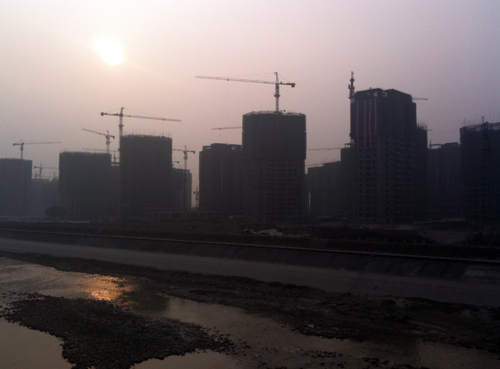
New development outside Jiangyou, Sichuan Province

The following post is an adaptation of a comment I made on my good friend and Chengdu-based American writer Sascha Matuszak’s recent ChengduLiving article about the development of the Chengdu-Chongqing Economic Zone. The comment recalls my own experience of a business trip to one of the smaller cities in the zone: Jiangyou, Sichuan Province:

Thanks for the update on the Chengdu-Chongqing Economic Zone, Sascha. Having been to several of the 3rd and 4th tier cities in Sichuan you mentioned (Suining, Mianyang, Nanchong, etc..) I’ve often wondered how the prosperity in the region’s two dominant cities (Chengdu and Chongqing) would trickle into these other cities as well.

It seems as if most of the young ambitious Chinese people I meet from these cities who now live in Chengdu feel like there is nothing left for them in their hometowns. They also tell me that if they want to move ahead the best opportunities are found in Chengdu or Chongqing.

This isn’t to suggest that Chengdu and Chongqing will continue being the only cities absorbing all the region’s young, educated and ambitious talents. As is clear from what you wrote, the government is pushing for the prosperity to spread throughout the region. And given the enormous combined population of Sichuan Province/Chongqing Municipality at a whopping 110 million people, this is certainly a reasonable plan.

Unfortunately, observations on the ground often tell a different story. About a year and a half ago I was in a city called Jiangyou (famous as the hometown of the poet Li Bai and now actually considered a part of greater Mianyang) to meet with a housing developer for a potential new project. The developer had just finished building a series of faux Italian-style villas on the outskirts of town and reveled in showing us the finished product. No one had moved in yet, but the units were sold out.

Why anyone would buy these villas as anything other than a pure (risky) speculative investment is beyond me. Quality of life couldn’t possibly be a factor. Just outside the gates of the project, the developer drove us around in his brand new Mercedes-Benz to show us what is Jiangyou’s newly planned ‘center’. At this time, it was nothing more than block upon block of empty dirt lots, cleared away for new development. No people in sight except for a few construction workers taking a cigarette break. There were absolutely no amenities in the area and the air full of dust.

The developer then drove us to the real center of Jiangyou about 5km down the road. Finally, signs of life abounded as local residents went about their day in the downtown area. Though the downtown Jiangyou locals didn’t look like they suffered from abject poverty, a brand-new Mercedes with a young laowai passenger inside was enough to stop people in their tracks and turn a lot of heads.

We stepped out of the car and walked through the center of town, which was a series of 1-2 story ramshackle shacks that were destroyed in the 2008 Wenchuan Earthquake. The buildings were too damaged to be safely occupied, yet markets still flourished in the pedestrian street directly in between the collapsed buildings.

The juxtaposition of the physical damage with the bustling life on the street gave the place the feeling of a disaster zone frozen in time. Given the time since the earthquake struck, I wondered why there hadn’t been any progress on clearing out the damage.

I got my answer when the developer took us to Jiangyou’s planning department- a bland, 5-story grey building with peeling paint, typical of government of offices in China’s 3rd and 4th tier towns.  Inside the building, there was not a soul in sight in the poorly lit hallways and stairwell until we got up to an office on the 3rd floor that reeked of stale cigarette smoke. A middle-aged man with a baijiu-belly offered us plastic cups of teas leaves with lukewarm water and introduced himself as one of the officials in charge of urban planning for the city. Maps of the city and region covering the walls of his office confirmed his position.

What we found out in that meeting is that despite an outward appearance that would suggest otherwise, the city of Jiangyou is rich. Or rather, the city government is sitting on top of piles of cash that was given to them by the central government as part of the Wenchuan Earthquake rebuilding effort. At that point, there was not much to show for the money they had received except for plans drawn up on paper. So far, our potential client, the developer of the luxury Italian villas had been one of the few in Jiangyou savvy enough to use his connections with the local government to gain favor and build the project, even though it was clear that the money might’ve been used for other, more pressing matters (e.g. clearing the rubble in downtown).

And while the planning official was soliciting master plans for redevelopment of the downtown area, most of the effort was still on developing the ‘new’ center with plans for new government offices and more luxury residential projects. I found it more than unfortunate that this took precedence over rebuilding the place where most of Jiangyou’s population lives.

Upon leaving Jiangyou, my Chinese colleague said something to me akin to “f*ck that guy”, in reference to the developer who showed us around. Apparently there was more going on than I could gather from my limited understanding of Chinese at the time.  Yet despite these misunderstandings, the physical state of the city said enough about where the rebuilding money was going.

Ultimately, it is the countless smaller cities like Jiangyou that will determine the future success of China (it is also good to keep in mind that city size is relative, and although Jiangyou is ‘small’ by China standards, the population sits at almost 900,000 people). With the upcoming government leadership change and an economy that begs for an evolution in its level of transparency, the fate of the country lies within its urban areas, especially the ones not on the international or even national radar.

9/11, China and the Enduring Symbolic Power of the Skyscraper

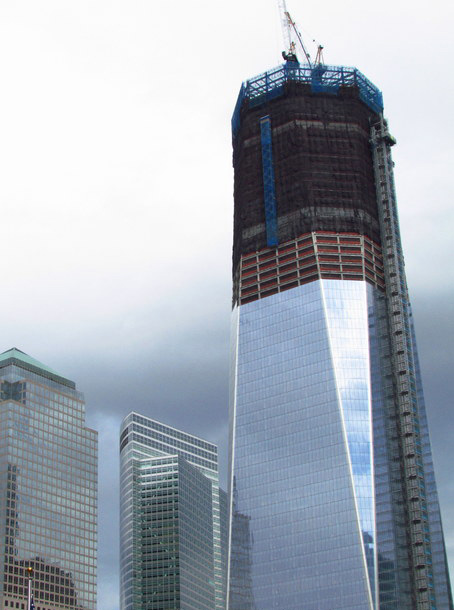
1 World Trade Center Rising in Lower Manhattan

Now that it has been about a month since the 10 year anniversary of the 9/11 attacks in the U.S., I have had some time to reflect on the enduring significance of the skyscraper. With One World Trade Center finally starting to form a new image in the Manhattan skyline, we see that in spite of protestations to building such a tower on sacred ground, construction crews move ahead to realize what will perhaps be the city’s most ambitious project in years. Some question why it has taken so long to get to this point while others still see the entire rebuilding effort as an affront to the memory of tragedy.

It really seems not long ago at all- I was barely into my third week of architecture school at the University of Southern California when terrorist attacks brought down the Twin Towers. Despite living in America’s second largest city at the time, it was difficult to fathom the horror that was taking place across the country in New York. Like everyone else around the world, my classmates and I watched the television in shock as we tried to process what was happening.

In the days and weeks that followed, I expected there to be some discussion in my classes about the symbolic power of architecture- more specifically an in-depth analysis as to why the World Trade Center was the target of such an attack. Surprisingly, my instructors were reluctant to talk about this topic and instead centered most of the discussions around debating the technical details about how the buildings failed.

Looking back, it is clear why Al-Qaeda chose the World Trade Center and the Pentagon, America’s respective symbols of commercial and military strength, as targets for attack. Yet why did my architecture professors fail to acknowledge this at the time?

For the younger instructors, I suspect the modernist paradigm had already ceased to be relevant since architectural historian Charles Jencks declared the death of modern architecture when Pruitt-Igoe, a failed public housing project in St. Louis designed by Minoru Yamasaki (who also designed the ill-fated World Trade Center), was imploded in 1972. For this generation of architects who were educated in the 1980′s and 90′s, it was the tongue-in-cheek classicism of post-modernism and the cynical musings of deconstructivists like Peter Eisenman and Bernard Tschumi who influenced their outlook. To them, I presume, the World Trade Center was already a dinosaur from another era long before the attacks that brought the towers down.

For the older generation of tenured professors, to question why the World Trade Center was the target of terrorist attacks was to question the entire legitimacy of the modernist project in the U.S.A. These are individuals whose careers fortuitously coincided with the golden age of American prosperity during the 1950′s, 60′s and 70′s. In retrospect, perhaps it was out of a sense of respect to the modernist paradigm in which they believed and spent their careers teaching aspiring architects that they not publicly question the ‘why’ of 9/11.

It was not until my first full-time job after graduating in the summer of 2006 that I fully grasped the symbolic power of architecture, specifically the skyscraper building type. I worked for an architect by the name of Richard Keating, who spent most of his career in the 1970′s and 80′s as a partner at Skidmore, Owings and Merrill (SOM), the gold standard in American corporate high-rise design. While at SOM, Keating designed several of the commercial office towers that define the skylines of cities like Houston, Dallas, and Los Angeles.

While many architects and commentators declared the end of the tall building type after 9/11, Keating was not among them. On the contrary, he understood the enduring appeal of skyscrapers not only to property developers and government officials, but also to the common man as an aspirational device.

Coincidentally, the first project I worked on in Keating’s office was a lobby renovation for Minoru Yamasaki’s other twin towers- the triangulated Century Plaza Towers in the Century City section of Los Angeles- originally built in 1975. Rather than let the modernist icon be relegated to the dust bin of history, we were tasked with updating the project’s public spaces with a 21st Century twist.

The Century Plaza Towers are a pair of classic high-rise towers of their era: pure rational forms in plan, extruded up 44-stories towards the sky

Building tall is somewhat formulaic as the considerations of natural forces such as gravity, wind, severe weather and potential seismic activity are always taken into great account when designing high-rise buildings anywhere in the world. Being as such, skyscrapers are just as much feats of engineering as they are architecture. In fact, some of the most recognizable skyscrapers make use of structure as the central focus of their architectural expression. One only needs to think of the cross-bracing structures of the Hancock Tower in Chicago or Bank of China building in Hong Kong to be reminded of this.

Bank of China building in Hong Kong by I.M Pei

Today the trend in high-rise design is not structural, but formal expression. Rather than being exposed for all to see, structure is now most often hidden behind shimmering glass curtain-walls while the towers twist and  torque upwards. Thanks to computer programs that allow architects to explore unconventional forms, skyscrapers need not be strictly Cartesian in nature.

“Absolute Towers” by Beijing-based MAD Architects in Mississauga, Canada

The ongoing economic crises in Europe and the U.S. put a dent into the skyscraper building program in the Western world. This is not the case in developing nations, especially China, where towers are rising in myriad cities across the country. When it comes to building the high-profile ‘supertall’ towers (buildings over 300 meter tall), Chinese clients still prefer to outsource the design to the experts with a track record in high-rise design, namely American firms like SOM, KPF, and Smith+Gill.

Yet these marquee projects do not account for nearly the thousands of other tall buildings over 100 meters being built in China, both in central business districts and outlying suburban areas. Most of these towers are nondescript and serve the straightforward purpose of housing an increasingly urbanized population. Perhaps bland on an individual level, collectively the high-rises that define rising skylines in Chinese cities represent the aspirations of an upwardly mobile population.

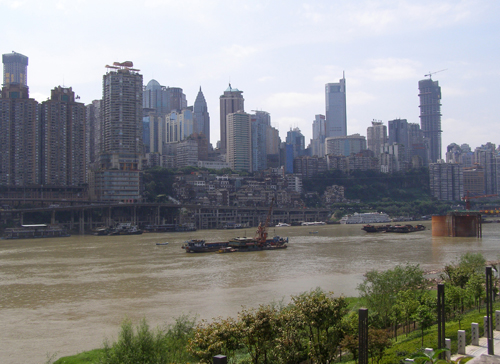
The Chongqing skyline, quickly becoming one of the most recognizable in the world

Cynics would argue that high-rise buildings in reality represent nothing more than real estate developer greed, benefiting few while exploiting the working class for cheap construction labor. While criticisms have their merit, the overwhelming consensus in China is in favor of a modernization program that includes the construction of tall buildings.

Not long ago I was walking down the new ‘financial street’ in Chengdu near my home where several new high-rise buildings between 150 and 200 meters tall are currently under construction. I noticed a beat-up car with license plates from a small Sichuan Provincial town stopped at a red light. Inside the car was a family of two parents and a child, looking up in awe at the glistening new skyline.

I knew at that moment that it didn’t matter if they never set foot inside those new buildings…what the towers represent was enough to inspire a sense of awestruck wonder in this family. And while American economists continue to bash China’s urbanization process, calling this the ‘biggest real estate bubble ever’, they tend to forget that it was in America that the skyscraper was invented and perfected. There is a certain universality of a desire to reach for the heavens, and China’s urban areas are the best reminders of that today.

A Guide to China’s Rising Urban Areas

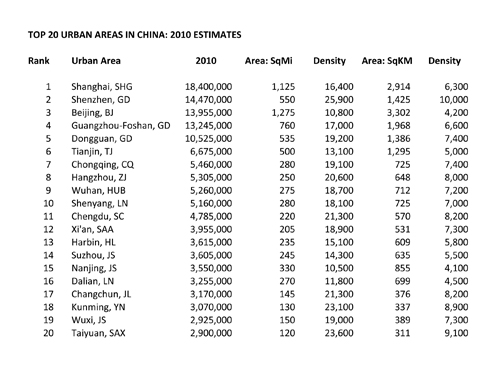
Source: Demographia World Urban Areas: Population & Projections: 6th Edition. http://demographia.com/db-worldua.pdf
 

I have a new piece up at NewGeography about China’s rising urban areas. Below is an excerpt from the introduction:

From a Rural to Urban Dispersion in the Middle Kingdom

China’s rise to economic prominence over the past 30 years has rested in large part to its rapid    urbanization. Prior to ‘reform and opening up’ that started in earnest during the 1970s, cities in China were viewed as pariahs by the party leadership. Millions of young urban dwellers were forced into the countryside to labor on farming communes during the Cultural Revolution. In stark contrast, today millions of rural migrants make their way to the city.

The scale at which this is happening is unprecedented. Currently, there are 85 metropolitan areas in China with more than 1 million people, compared to 51 in the US. By 2015, urban regions will account for half of China’s population and by 2025, the urban population’s share should reach about 75%.

To date, international attention has remained fixated on China’s largest cities of Beijing and Shanghai (and to a lesser extent, Guangzhou and Shenzhen). This is not without good reason, as Beijing and Shanghai are not only the respective government and financial centers of mainland China, but both were host to two of the most visible world events of the past decade: the 2008 Summer Olympics and the recently concluded World Expo.

Second and Third-Tier Cities Enter Onto the World Stage

Increasingly, however, the real trajectory of urban growth is shifting to China’s so-called ‘second-tier’ and ‘third-tier’ cities. To the outside observer, China’s lesser-known cities might seem all too similar to one another given the monotonous aesthetic of their newly constructed cityscapes. Indeed, the newfound appearance of Chinese cities is a point of contention among local urban development scholars who are concerned about the converging ‘identical faces’ of these urban areas.

Yet to Chinese locals and foreigners who have spent some time living here, it Chinese cities are defined more by their local cuisine, dialect, history, geography, culture and climate rather than their architectural character. These often-overlooked nuances of local culture are much more essential to the identity of these cities than buildings. In the future, these distinctions may prove more effective in attracting investment and talent than flashy new construction projects.

To continue reading about these cities please click here.

Chengdu and Chongqing Leading the Way in Hukou Reform

The hukou system, or household registration system, is a method of accounting for the country’s population by requiring each citizen to officially register his or her place of residence.

Possessing an urban hukou in a large city means that one is an official ‘resident’ of that city and eligible to receive benefits such as  access to medical insurance and education as well as the right to purchase property. This poses a problem for the floating population of rural migrants to cities who are not afforded similar benefits due to their lack of an official urban hukou.

Given the difficulty rural migrants have in obtaining an urban hukou, most have no incentive to settle in a city once their period of work is finished. This means that until the system is reformed, rural migrants will always have one foot in the big city and one foot back in the village.

When China first opened up 30 years ago, opportunity was limited to places like the Pearl River Delta, where access to overseas markets made it the logical place to begin economic reform. As economic growth and prosperity has spread from the coastal regions to the interior, migrants from the western part of China have less incentive to head all the way to coastal areas to look for work. In fact, the Pearl River Delta has even seen a migrant worker shortage recently.

The expansion of economic growth throughout China has been of great benefit to interior cities like Chengdu and Chongqing- both large cities surrounded by vast rural areas. The growth of these two cities means that rural migrants from Sichuan and nearby provinces need not go too far in order to find good job opportunities.

Seizing the opportunity to strengthen urban growth, both Chongqing and Chengdu are taking the lead in hukou reform. Chongqing recently pledged to grant 3 million urban hukous to farmers by 2012, and 10 million altogether by 2020! Chengdu has initiated a pilot program to unify rural and urban hukous, granting access to urban unemployment benefits for migrant workers.

It is clear that hukou reform is the key to long-term successful urbanization of China’s cities. While economic reforms first emerged in China’s coastal areas, could social reforms arise from the country’s great cities on the interior?

China Daily: Chongqing Turns Into Red Capital

Chengdu Living: Chengdu’s Pilot Program to Abolish the Hukou