Chengdu’s First Subway Line Set to Open

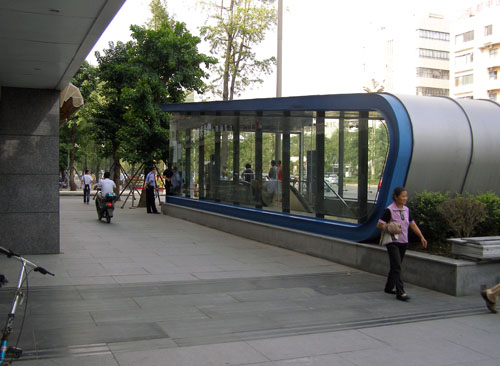
Entry shell to the new Chengdu underground metro

October 1st, 2010 will be a momentous day in the Sichuan capital of Chengdu. On this day, the city will inaugurate its first subway line: Line 1. This is significant not only because road traffic is getting increasingly worse in the city and more alternatives for getting around town are much-needed, but also because it represents to the citizens of Chengdu a rite of passage into modern China.

Line 1 of the Chengdu Metro traverses a north-south axis through the middle of the city, reaching from the older neighborhoods in the north to the newly developed high-technology zones in the south. In the center is the Tianfu Square station, where Line 1 and Line 2 are set to converge in the future making it a critical transfer hub. Continue reading

Development in the Far West: Bumpy Road Ahead

Uyghur people in Xinjiang. Photo courtesy of Nicolas Marino

One advantage of China’s top-down approach to urban development is the lack of organized resistance to new projects. Aside from the occasional story of a  lone-ranger hold out protesting imminent demolition of property, China is a nation almost completely devoid of NIMBYs (not in my backyard). This is due largely in part to the collectivist nature of China’s ethnic majority.

That majority is of course the Han people, who comprise more than 90% of China’s overall population. There is a very strong self-identification among the Han, which begets an unspoken but omnipresent social unification. This spirit has been one of the driving forces behind China’s rapid and successful urban development.

Yet as momentum shifts  westward, the outlook for peaceful development looks more uncertain. Whereas the east coast of China consists mainly of Han people, the interior areas are more mixed ethnically. The far west autonomous regions of Tibet and Xinjiang are majority-minority populations. Continue reading