Category Archives: Demographics
China’s Urbanites Take to the Internet in Droves
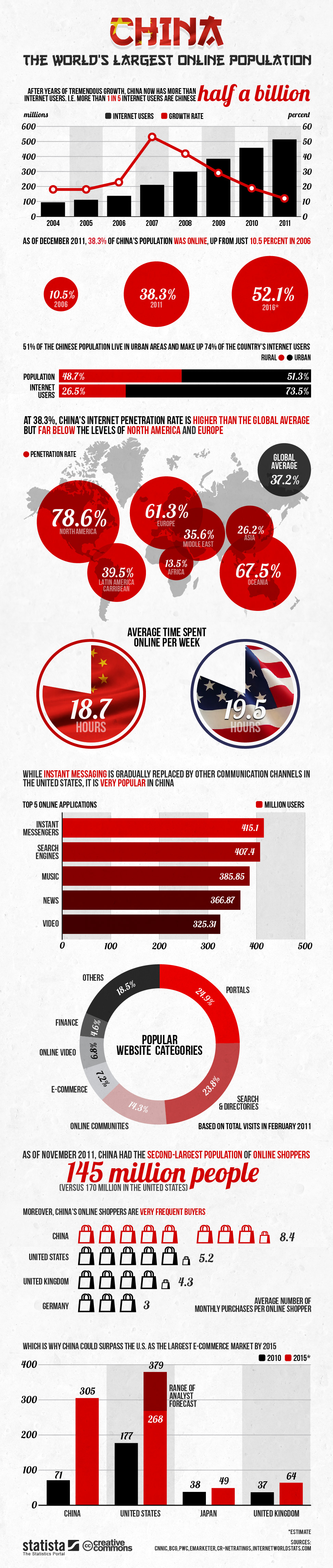
The good people over at Statista provided us with yet another excellent China infographic, this time about the country’s huge online population. Already, 1 in 5 worldwide internet users is Chinese, yet still less than half of the country’s population is online. Most of those are people living in China’s urban areas, accounting for 73.5% of those online. That statistic and the overall number of people using the internet is bound to increase with the technological advantages that urban areas continue to afford over rural areas.
The world of microblogging is also exploding. China’s version of Twitter, called Weibo, is already a paradigm-changing social phenomenon with over 300 million registered users. Although strict government controls routinely restrict searches for sensitive topics, savvy netizens find ways around these blockades through the use of aliases and codewords. For instance, while the ongoing saga surrounding the recent escape of blind dissident Chen Guangcheng from house arrest has led authorities to block searches for his name, Weibo users are creatively microblogging around the sensors .
It might be too early to assess the full extent of influence that widespread internet use has on Chinese society, but it is safe to assume that it has already changed the social landscape in significant ways.
1.3 Billion: A Demographic Reminder
Every now and again, I like to take a step back and refocus on China demographics to bring to light the sheer scale of the country in terms of population and economic growth. I do this because there are many commentators who still question the whole China urbanization program, scratching their heads while myopically looking at the same handful of so-called ‘ghost cities’ (many of which are actually mere districts of much larger municipalities).
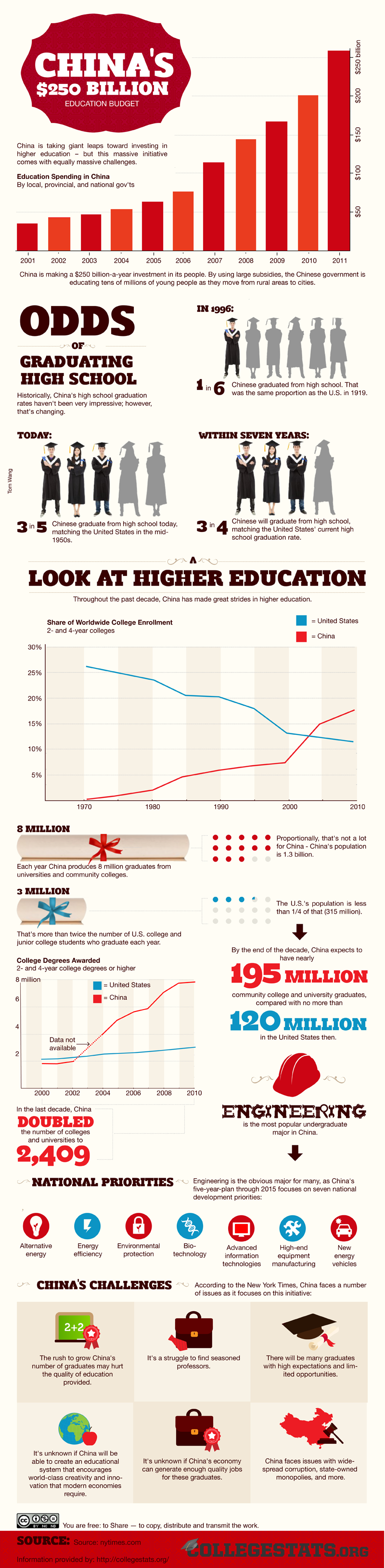
The above chart from Statista spells out the current demographic/economic situation in China very clearly. China has more than 1.3 billion people. To put it into perspective, imagine the U.S. with about 1 billion added inhabitants, now imagine trying to manage an economy with that many people growing at about 9%-10% per year while keeping unemployment down to around 4%. As one can see, this is not a simple task as the inflation rate shot up about 6% since 2009.
Rising inflation is one huge issue currently facing China policy makers. Another one, albeit less pressing at the moment, is the slowing rate of population growth. While the controversial one-child policy instituted over 30 years ago was a success from a macro policy perspective, the unforeseen social issues resulting from the policy (low number of females to males, the burden of being an only child in a family oriented society, etc…) foreshadows economic consequences 10-20 years down the line when there are not enough young workers to replace and take care of a gigantic aging population.
And from my own personal encounters, though the one-child policy eased up significantly in recent years, most aspiring young middle-class Chinese living in urban areas opt to wait to have children and when they do, limit themselves to one (even if they are no longer constrained by the one-child policy). This has to do with several factors, including the pressure to move up the social ladder by buying a house and car, the cost of a child’s education, and the cost of taking care of two sets of aging parents.
In the meantime though, my conservative prediction is that China has about 5-10 years left of strong economic growth. The per capita GDP is still remarkably low, mostly due to the hundreds of millions still living in rural areas. The potential to earn much higher wages in urban areas (where salaries are raising rapidly) ensures that there is a steady of influx of people into cities.
View from the Ground in the Chengdu-Chongqing Economic Zone
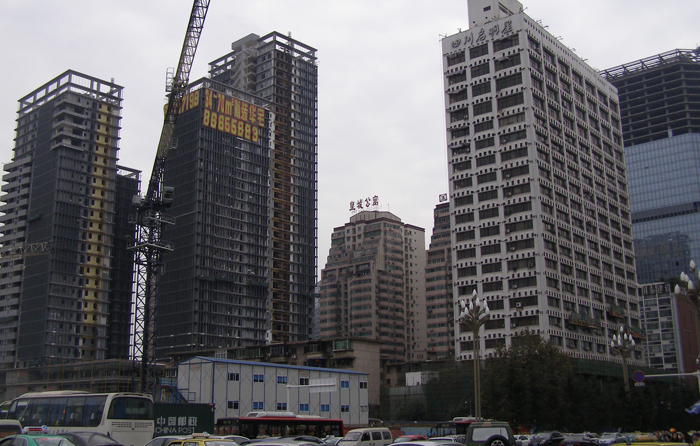
New development outside Jiangyou, Sichuan Province
The following post is an adaptation of a comment I made on my good friend and Chengdu-based American writer Sascha Matuszak’s recent ChengduLiving article about the development of the Chengdu-Chongqing Economic Zone. The comment recalls my own experience of a business trip to one of the smaller cities in the zone: Jiangyou, Sichuan Province:
Thanks for the update on the Chengdu-Chongqing Economic Zone, Sascha. Having been to several of the 3rd and 4th tier cities in Sichuan you mentioned (Suining, Mianyang, Nanchong, etc..) I’ve often wondered how the prosperity in the region’s two dominant cities (Chengdu and Chongqing) would trickle into these other cities as well.
It seems as if most of the young ambitious Chinese people I meet from these cities who now live in Chengdu feel like there is nothing left for them in their hometowns. They also tell me that if they want to move ahead the best opportunities are found in Chengdu or Chongqing.
This isn’t to suggest that Chengdu and Chongqing will continue being the only cities absorbing all the region’s young, educated and ambitious talents. As is clear from what you wrote, the government is pushing for the prosperity to spread throughout the region. And given the enormous combined population of Sichuan Province/Chongqing Municipality at a whopping 110 million people, this is certainly a reasonable plan.
Unfortunately, observations on the ground often tell a different story. About a year and a half ago I was in a city called Jiangyou (famous as the hometown of the poet Li Bai and now actually considered a part of greater Mianyang) to meet with a housing developer for a potential new project. The developer had just finished building a series of faux Italian-style villas on the outskirts of town and reveled in showing us the finished product. No one had moved in yet, but the units were sold out.
Why anyone would buy these villas as anything other than a pure (risky) speculative investment is beyond me. Quality of life couldn’t possibly be a factor. Just outside the gates of the project, the developer drove us around in his brand new Mercedes-Benz to show us what is Jiangyou’s newly planned ‘center’. At this time, it was nothing more than block upon block of empty dirt lots, cleared away for new development. No people in sight except for a few construction workers taking a cigarette break. There were absolutely no amenities in the area and the air full of dust.
The developer then drove us to the real center of Jiangyou about 5km down the road. Finally, signs of life abounded as local residents went about their day in the downtown area. Though the downtown Jiangyou locals didn’t look like they suffered from abject poverty, a brand-new Mercedes with a young laowai passenger inside was enough to stop people in their tracks and turn a lot of heads.
We stepped out of the car and walked through the center of town, which was a series of 1-2 story ramshackle shacks that were destroyed in the 2008 Wenchuan Earthquake. The buildings were too damaged to be safely occupied, yet markets still flourished in the pedestrian street directly in between the collapsed buildings.
The juxtaposition of the physical damage with the bustling life on the street gave the place the feeling of a disaster zone frozen in time. Given the time since the earthquake struck, I wondered why there hadn’t been any progress on clearing out the damage.
I got my answer when the developer took us to Jiangyou’s planning department- a bland, 5-story grey building with peeling paint, typical of government of offices in China’s 3rd and 4th tier towns. Inside the building, there was not a soul in sight in the poorly lit hallways and stairwell until we got up to an office on the 3rd floor that reeked of stale cigarette smoke. A middle-aged man with a baijiu-belly offered us plastic cups of teas leaves with lukewarm water and introduced himself as one of the officials in charge of urban planning for the city. Maps of the city and region covering the walls of his office confirmed his position.
What we found out in that meeting is that despite an outward appearance that would suggest otherwise, the city of Jiangyou is rich. Or rather, the city government is sitting on top of piles of cash that was given to them by the central government as part of the Wenchuan Earthquake rebuilding effort. At that point, there was not much to show for the money they had received except for plans drawn up on paper. So far, our potential client, the developer of the luxury Italian villas had been one of the few in Jiangyou savvy enough to use his connections with the local government to gain favor and build the project, even though it was clear that the money might’ve been used for other, more pressing matters (e.g. clearing the rubble in downtown).
And while the planning official was soliciting master plans for redevelopment of the downtown area, most of the effort was still on developing the ‘new’ center with plans for new government offices and more luxury residential projects. I found it more than unfortunate that this took precedence over rebuilding the place where most of Jiangyou’s population lives.
Upon leaving Jiangyou, my Chinese colleague said something to me akin to “f*ck that guy”, in reference to the developer who showed us around. Apparently there was more going on than I could gather from my limited understanding of Chinese at the time. Yet despite these misunderstandings, the physical state of the city said enough about where the rebuilding money was going.
Ultimately, it is the countless smaller cities like Jiangyou that will determine the future success of China (it is also good to keep in mind that city size is relative, and although Jiangyou is ‘small’ by China standards, the population sits at almost 900,000 people). With the upcoming government leadership change and an economy that begs for an evolution in its level of transparency, the fate of the country lies within its urban areas, especially the ones not on the international or even national radar.
World’s Longest Sea Bridge Opens in Qingdao
To mark the 90th Anniversary of the founding of the Communist Party two weeks ago, the seaside city of Qingdao in Shandong province opened its new Jiaozhou Bay bridge. At 42.4 km, it is the longest sea bridge in the world. The bridge links historic Qingdao with the city’s industrial zone Huangdao.
On the same day, a 9.47 km undersea tunnel also opened linking the two sides together. As Steve Dickinson of the China Law Blog points out: “The completion of the bridge and tunnel fulfills the long term dream of the Qingdao government to fully integrate the two shores of the Jiaozhou Bay.“
Dickinson goes onto wonder about the possible redundancy of not one but two links across the bay given the high public expenditures of both these projects. At the end of his post, which is titled ‘Qingdao’s New Bridge As Symbol of China Infrastructure‘, he says:
“Nobody is even sure why either the bridge and the tunnel were built, much less the two of them. The bridge seems to be mostly aimed at connection by highway for goods from the ports and airport and tradezones. The tunnel does not provide access to any of this. The high toll for the tunnel means that it will not be used for normal surface transport (private cars and taxis). So why was it built? No one has ever been able to provide me with an explanation. Why was the bridge built at the WIDEST part of the bay? Why was it built when it only provides a 10 minute improvement in travel time? Why was it built with no attention to access and exit? Why were the connecting highways not improved? Who knows.”
Dickinson touches upon what is potentially the most contentious issue about China’s infrastructure: the seldom examined cost/benefit analysis of these new projects. At this point the world knows that China can ‘get it done’ when it comes to building large-scale infrastructure projects. There is no lack of political will or labor to undertake such ambitious plans. Yet lost in the speed of getting these new projects built is a rigorous analysis of the ultimate benefits for what could turn out to be a series of boondoggles.
That is not to suggest that this is not to be expected, especially given that China is a still a developing country. Surely, many of the infrastructure projects will have tremendous benefit now and in the future. I also posit that to some extent China’s leaders are aware of potential labor shortages in the future. As China’s aspiring middle-class urban dwellers move up the value chain, and as the one-child policy begins to take a toll on the country’s youthful demographics, cheap labor will become more scarce.
Given this reality, China appears to be taking an approach that puts speed and ambition above all other considerations, waiting to deal with the details later on. In a sense, this is a cultural phenomenon: creating an environment of rapid growth to ensure social stability and avoid the internal chaos that is still all too near in memory.