Category Archives: Retail

An Experience in Contrasts: Redevelopment in Beijing’s Historic Qianmen Neighborhood

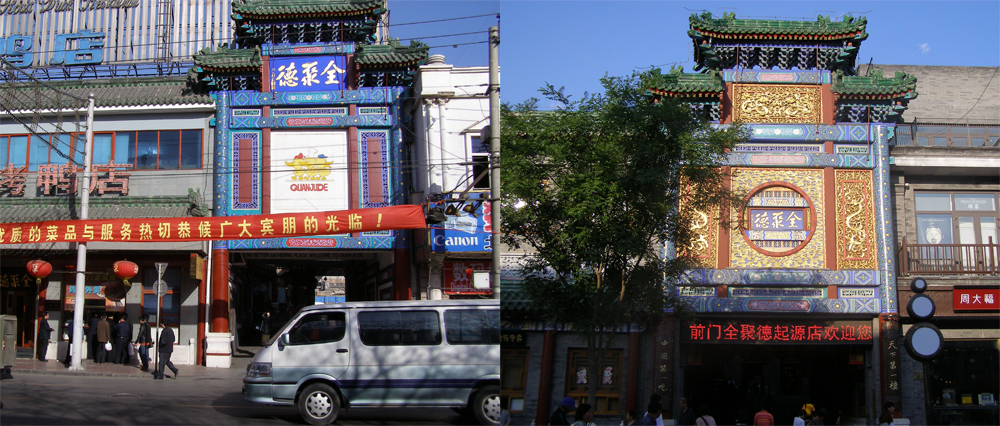
Before and After Photos of ‘Quanjude’, a famous Peking Duck Establishment in Qianmen Since 1864

It is a familiar narrative across China’s cities: historic districts routinely razed to make way for new developments comprised of high-rise residential communities and retail mixed-use complexes designed to reflect China’s 21st Century image.

Yet in some of China’s more high-profile historic neighborhoods, redevelopment is conceived to capture the spirit what was once previously on site by rebuilding in traditional Chinese architectural styles. ‘Tourist Streets’, as these kinds of developments are referred to by developers and government officials, are a hot project type in China- nearly every city wants one. They range from accurate recreations of China’s past to cheap pastiche.

In some exceptional cases, such as Xiantiandi in Shanghai and Kuan Zhai Xiang Zi in Chengdu, serious efforts were made to preserve some of what was already there and reuse materials from demolished buildings. In most instances though, the practice of completely demolishing/rebuilding remains the typical Chinese development modus operandi.

One of the most controversial instances of the demo/rebuild type of historic redevelopment is the Qianmen area of Beijing, a neighborhood directly south of Tiananmen Square. Thanks to its adjacency to the heavily visited city center, Qianmen (which translates to ‘Front Gate’) is a popular tourist area with several shops and restaurants.

Similar to other developments around China, thousands of residents were relocated for redevelopment in Qianmen. Yet given its high-profile location, the project received a lot of heat, not only from preservationists but from local Beijing residents as well, many of who have connections to the tight-knit community.

I first wandered into Qianmen on a visit to Beijing back in 2006. At that time, the neighborhood was in full-scale transition, with demolition of old courtyard siheyuan buildings taking place at an alarming pace. Despite the dust and noise, retail commerce, which consisted of small family-owned shops selling touristy knick-knacks and knock off goods, thrived in the area.

Qianmen in 2006: Still Retaining Some Original Character but Redevelopment Commencing

Qianmen in 2011: Pedestrian Street Directly South of Tiananmen Square Rebuilt Completely in Qing Dynasty-era Architecture

Although Qianmen Street, the main pedestrian thoroughfare bisecting the neighborhood, officially reopened just in time for the Beijing Olympics in 2008, I didn’t make it back to the area until last year. When I finally did make it back, the area was completely unrecognizable from what I saw in 2006.

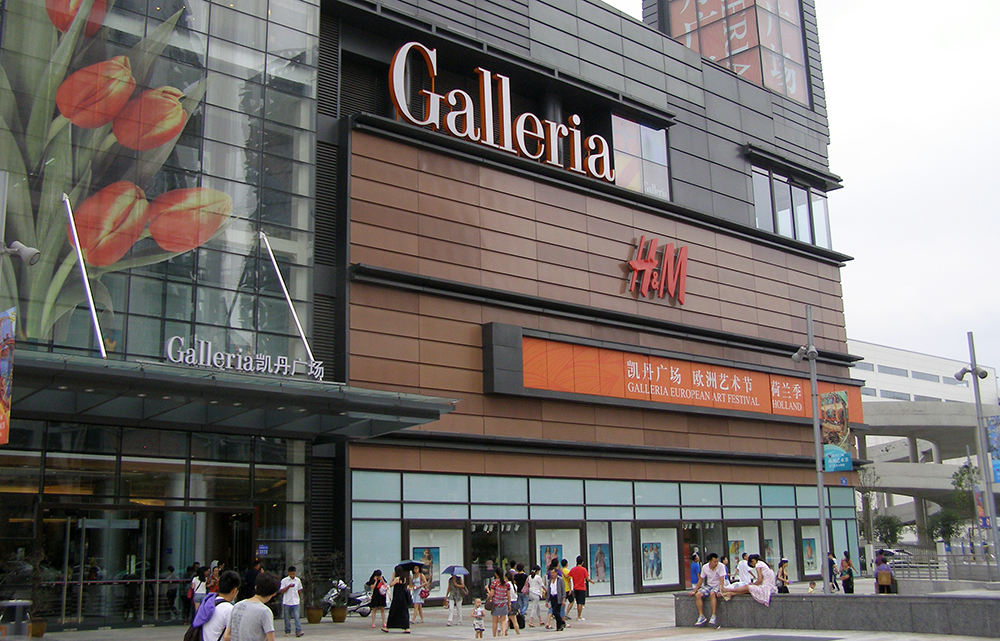
Ramshackle old buildings and maze-like narrow alleys were replaced by new retail buildings evoking Qing-era architecture lining a wide avenue with a trolley car (which reminded me of another outdoor pedestrian mall across the Pacific: The Grove in Los Angeles). Mom and pop shops selling questionable goods were replaced by international retail chains such as Starbucks, Häagen-Dazs, New Balance and H&M. The only landmark that remained (and which I recognized from its memorable sign) was the famous Quanjude Peking Duck restaurant.

Perhaps most interesting though was not the new tourist street itself, but the current state of the surrounding area. Directly east of Qianmen Street, new construction extended for several blocks, continuing in the same new/old Qing style of the tourist street. Much of the construction was already complete, but the retail spaces remained mostly empty..

The other (west) side of Qianmen Street was an experience in contrasts. The narrow and crowded streets flowing through the old single story siheyuans reminded me of what the area looked like back in 2006. Sure enough, this area had escaped development up to this point but given its inconsistency with plans for the overall neighborhood it is a sure thing this area will eventually be redeveloped as well.

It might be too late for preservation in Qianmen, but the public outcry against the redevelopment there prompted preservationists to put a stop to plans for another large project in a historic district not too far away: The Drum and Bell Tower ‘Gulou’ Area north of the Forbidden City. With advocacy from the Beijing Cultural Heritage Protection Center, preservationists were able to convince the government to greatly scale back plans to redevelop a 12.5 hectare area in the Gulou neighborhood.

Once a very sensitive topic in China, historic preservation is now discussed openly among stakeholders. With much of the country’s architectural history lost in the rush to develop, a new generation is ever more aware of the importance of what is left. Given this shift in dialogue, it will be interesting to see how the new leadership in Beijing approaches the subject when it takes office next year.

24 City Rises in Southeast Chengdu

The sound of new development roars all over Chengdu. One area that is particularly on the uptick is the southeast, just outside the 2nd Ring Road. Not long ago a heavy industrial zone, several former factory sites were cleared to make way for new high-density residential, retail and office development.

Today the area is a gigantic series of noisy, dusty construction sites. Not only is abundant new real estate floor space being built, but the area is making way for two upcoming metro lines: line 2 and line 4. Though only 4.5 km from the city center, the area feels worlds away from the city’s historic core. Yet as Chengdu continues to sprawl out, the new development is bound to become part of the urban area within a few years.

24 City is 4.5 km south-east of Chengdu’s city center (highlighted in purple)

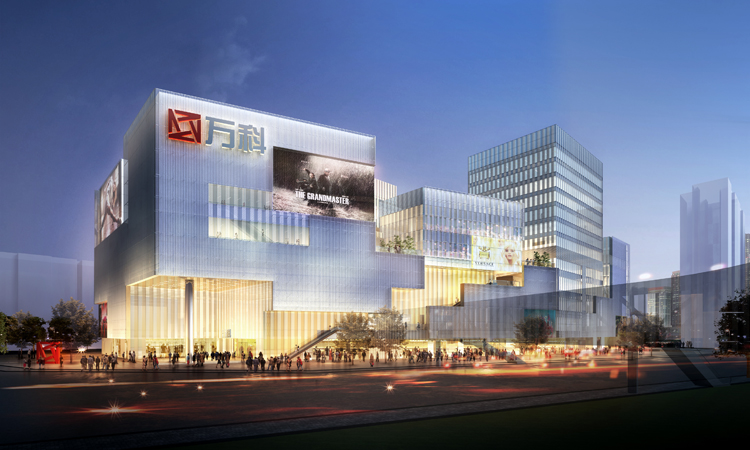
One of the large new developments in this area is 24 City, spanning several blocks with a new shopping mall, office and residential towers. The shopping mall and office tower are designed by American architecture firm Callison and is rounding out construction.

Callison-designed terraced shopping mall

A new office tower rises out of the shopping mall podium

The retail podium topped out with office tower is the standard formula for commercial mixed-use developments across Chengdu (and China). The almost complete buildings are only Phase I, which is planned to be followed by several more phases of retail podium + towers on top.

Across the street from the shopping mall are two new residential compounds with clusters of dozens of tall buildings. A quick peek into one of the sales centers confirmed that the new units have no problem being sold off. Whether intended as speculative investments or primary residences, the investments are bound to payoff as the proximity to the planned subway stops means that this will soon be a convenient area for moving around the city by public transit.

Unfortunately the design of the residential compounds leave much to be desired. On one side, a row of regimented towers lines the adjacent public street, creating an ominous canyon of darkness. The inside of the compound is a much more pleasant environment, with well-kept landscaped grounds punctuated with water features.

Tragically, these areas of respite lay behind electric fences and are for residents only. So, despite giving off the image of ‘real’ urbanism (dense clusters of high-rise towers), theses developments are no different from the gated communities of sprawling American suburbia. In the end, 24 City is unremarkable in that it follows the same pattern of brand-new development being followed in countless other Chinese cities without breaking any new ground.

China and the Legacy of Steve Jobs

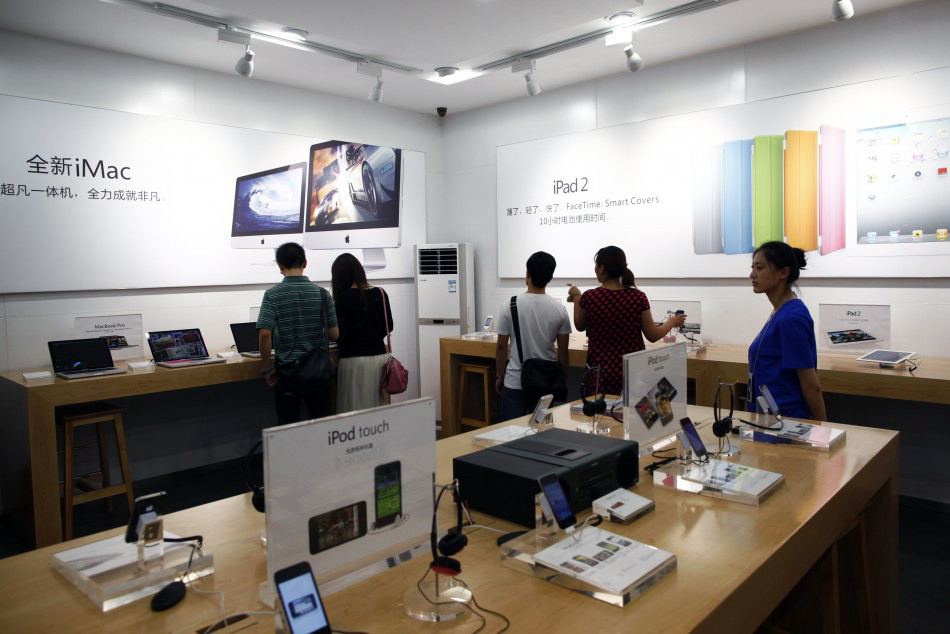
Fake ‘Apple Store’ in Kunming

It is not hard to understate the influence that Apple has had on China. If we examine the role the country plays in the supply-chain of Apple products, then China’s relationship with the company is undeniable. It is safe to say that without China’s contribution to the manufacturing and assembly process, Apple’s stylish products would be unaffordable to the average consumer around the globe.

That’s why last year when a string of suicides hit Foxconn, the company that manufactures products such as the iPad and iPhone, Steve Jobs was quick to announce that Apple would look into the working conditions. Jobs, a marketing genius, knew that negative PR associated with Foxconn would hurt Apple’s sleek and stylish image in the U.S.

What commentators in the U.S. failed to notice is the relative ambivalence of people in China regarding the Foxconn suicides. When I asked my Chinese colleagues what effect the incident had on their perception of Apple, they responded that there was absolutely none. Not only that, they defended Foxconn by saying that the rate of suicides among workers (there are tens of thousands of them) is not abnormal for society at large.

The willingness to defend Apple and its manufacturer is a testament to the huge popularity of the brand in China. From first-hand observation, it seems that Apple products are as ubiquitous here as they are in my native Silicon Valley. It is certainly not only about function- rather, owning an iPhone or iPad is akin to owning a luxury handbag from Hermes or Prada. I know many people who are willing to spend 2 or 3 months salary or even borrow money from friends to purchase an iPhone.

Perhaps more baffling is the fact that Apple products cost more in Mainland China than they do outside. This defies logic given that most of the products are made here…one would think that a reduction in transport cost would bring the price down. The reality is that despite being ‘made in China’, Apple products are treated as ‘imports’ and are taxed as such. This is done to encourage the consumption of domestic products rather than foreign competitors.

The high price point has done nothing to deter Chinese consumers from buying Apple products. Even when the comparable Lenovo tablet computer is advertised for 1000 RMB (~$156.00 USD), Chinese consumers are willing to pay 4 to 5 times that price just to have the iPad.

Furthermore, the desire for Apple products has created an illicit industry of smuggling from Hong Kong and other places. Not long ago, authorities shut down a zipline stretching across the border from Hong Kong into the Mainland city of Shenzhen. Flying on that zipline was none other than shipments of  iPads. Women in overcoats concealing a body covered in iPhones and iPads have also been caught trying to cross the border between Hong Kong and Shenzhen.

In a country known for its knock off products, Apple products are worth the price of their authenticity (even if those real products are purchased in ‘fake’ Apple Stores). Given this fervor, the overwhelming reaction from Chinese Apple fans upon hearing about the passing of Steve Jobs is not surprising. Netizens took to Weibo (China’s ‘Twitter’) commemorating his contributions to the world. Others visited Apple vendors around the country to offer their condolences in person.

Steve Jobs’ popularity in China demonstrates a universal admiration for ground-up innovation and entrepreneurship. Despite having a reputation as a culture that discourages innovation and forces workers to ‘toe the line’ in order to maintain social stability, China’s rising living standards and gradual shift to consumer economy will create an environment more conducive to the kinds of innovations that have come out of places like Silicon Valley in the past.

American economist Panos Mourdoukoutas disagrees with this notion in a recent Forbes article (Why China Doesn’t Have It’s Own Steve Jobs). Mourdoukoutas cites the ‘nature of Chinese institutions’ and ‘lack of incentives to develop pioneering products’ as reasons for this being the case. While looking back at the past few decades, his observations might be correct, looking into the future, he could not be more off the mark.

As I have said before, China’s economy is in a constant evolutionary state. What may appear a static, archaic, and centrally controlled beast from the outside is certainly not reality within China. One only needs to look at the evolution of China’s neighbors, Japan and South Korea- both places once known as bastions of intellectual property theft- to get an idea of where China is headed in the innovation department. Only this time, the scale will be much larger.

Only once the country’s ‘hardware’ (infrastructure, buildings, etc…) is in place, will China make the full shift to a more consumer driven economy. Mourdoukoutas finally acknowledges this reality at the end of his piece:

“To have its own celebrated entrepreneurs, China must develop a consumer-centered market economy that releases the ingenuity and creativity of its people in the search for novel ways to change consumers’ lives, amassing wealth for themselves in the process.

On the ground here this is already happening, but the process might be too gradual for outside observers to see. If reverence for Steve Jobs is any indication, China is in for a golden age innovation and entrepreneurship…the people here are hungry for it.