Politicizing the Pritzker

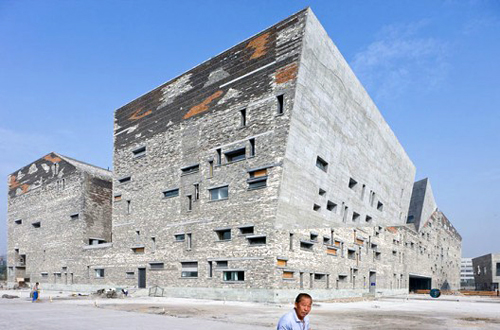
Ningbo History Museum by architect Wang Shu

Last month, this year’s Pritzker Prize (architecture’s highest honor) was awarded to Chinese architect Wang Shu. The announcement was surprising for a few reasons. For one, consensus around the architecture blogosphere was that the award would go to a more high-profile architect such as Toyo Ito or Steven Holl, both looked over in recent years. Secondly, assuming that the Pritzker jury intentionally chose a Chinese architect, there were others who could have been considered such as Zhu Pei, Ma Qingyun, or Ma Yansong (perhaps still a bit too young).

The Chinese architects mentioned above derive inspiration from China’s ascendancy towards the future, pushing the limits of avant-garde building form. Wang Shu’s architecture, on the other hand, is rooted more in the past, exuding firmness and strength. In this regard, Wang’s architecture is more like last year’s Pritzker winner, Portugal’s Eduardo Souto de Moura, than his Chinese counterparts. Continue reading
High-Speed Train Derails in Zhejiang Province

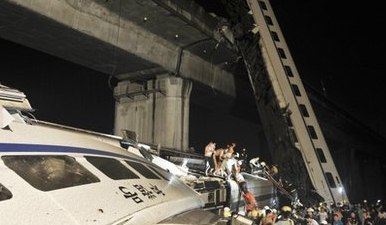
In a gigantic blow to the credibility and safety of China’s high-speed rail network, a train traveling from Zhejiang’s provincial capital of Hangzhou to the seaside city of Wenzhou derailed Saturday evening. Details at this point are still developing, but so far reports have said that the train was struck by lightning and then subsequently hit by another train, leading to two of the train’s cars falling from a bridge. So far, 16 passengers are reported dead and 89 injured. Continue reading

A Guide to China’s Rising Urban Areas

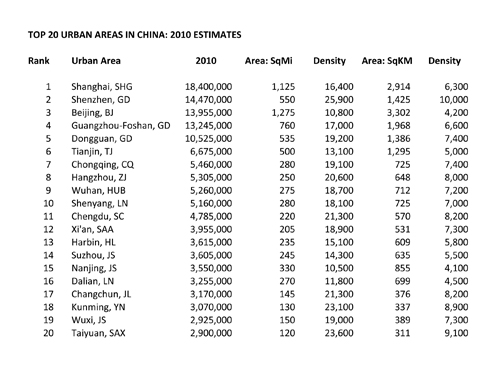
Source: Demographia World Urban Areas: Population & Projections: 6th Edition. http://demographia.com/db-worldua.pdf
 

I have a new piece up at NewGeography about China’s rising urban areas. Below is an excerpt from the introduction:

From a Rural to Urban Dispersion in the Middle Kingdom

China’s rise to economic prominence over the past 30 years has rested in large part to its rapid   urbanization. Prior to ‘reform and opening up’ that started in earnest during the 1970s, cities in China were viewed as pariahs by the party leadership. Millions of young urban dwellers were forced into the countryside to labor on farming communes during the Cultural Revolution. In stark contrast, today millions of rural migrants make their way to the city.

The scale at which this is happening is unprecedented. Currently, there are 85 metropolitan areas in China with more than 1 million people, compared to 51 in the US. By 2015, urban regions will account for half of China’s population and by 2025, the urban population’s share should reach about 75%. Continue reading