Category Archives: Real Estate

Why is Zaha Hadid being copied in China?

Zaha_copied in ChinaZaha Hadid’s Wangjing SOHO design (left). Chongqing Meiquan 22nd Century design (right). Image from AFP.

Earlier this year, the architecture world was in shock after a story made the rounds that a Zaha Hadid designed project in Beijing is being pirated by a developer in Chongqing. What’s surprising about this story is not the actual copying of Hadid’s design but the reaction from the design media, as if this is the first incidence of architectural piracy in China.

Of course this is not the case as building designs are routinely copied in China. However, what makes this instance unique is that while Hadid’s design (Wangjing SOHO) is still under construction, the copied version (Chongqing Meiquan 22nd Century) is set to complete first. Pan Shiyi, Board Chairman of SOHO China, Hadid’s client, has not kept quiet about his disapproval, and is now taking legal action against the developers in Chongqing.

This situation brings up the reoccurring discussion about authenticity (or lack thereof) in China. It is no secret that China ‘learns by imitation’ in everything from product design to software development. In the realm of architecture, it is not uncommon to come across functioning replicas of famous buildings from history (like the Chrysler Building, Sydney Opera House, or the entire Austrian Village of Hallstatt) in China’s cities.

Hadid’s office speculates that perhaps someone got hold of their plans for Wangjing SOHO to produce the copy. Yet having seen Chinese architects in action, it would not be far-fetched to speculate that the designers of Chongqing Meiquan 22nd Century saw nothing more than a computer rendering of Hadid’s project on the internet to generate something of similar likeness.

Architects around the world learn from other architects. Websites like ArchDaily are a great resource for architects to promote their work and for other architects to get inspired. Like professional writers, there is an unspoken ethical code among architects about borrowing from other designers: re-using certain ideas or building elements is ok, even flattering at times, but outright plagiarism is never ok.

This code of design ethics doesn’t exist (yet) in China. As is often the case, copying a famous design from another architect can be a good strategy in getting approval from a Chinese client or local government official. In response to the accusation of copying, developer Chongqing Meiquan even said “never meant to copy, only want to surpass.”

This response is very telling of where the value of architectural design lies today in China. While it could be argued that China is still in its “learning phase” of development, it is starting to become clear that the country’s ambitions lie much further beyond not only being the ‘biggest’ but the ‘best’ – even if that means using dishonorable means to get there.

Interview with Bianca Bosker, Author of New Book “Original Copies: Architectural Mimicry in Contemporary China”

BBoskerBook

The widespread pirating of architectural motifs in China’s developing urban landscape is a well-documented phenomenon. From Alpine Villages to starchitect-designed superstructures, Chinese builders often seem to have no shame in copy and pasting designs originating from far away places.

This perplexing and culturally intriguing topic is the subject of a new book by Bianca Bosker, Executive Tech Editor for The Huffington Post. Original Copies: Architectural Mimicry in Contemporary China (University of Hawaii, 2013) examines the trend of “duplitecture” in China – the construction of monumental, themed communities that replicate the cities and towns of the West, frequently drawing on historical European archetypes.

Bianca was nice enough to answer some questions to help give us a better idea of what her book is about:

Adam Mayer (AM): What prompted you to write a book about architectural mimicry in China and how did you become interested in this topic? What message are you trying to convey by writing this book beyond showcasing the fact that China likes to copy buildings?

Bianca Bosker (BB): My interest in this architectural movement started during a research trip to China when I first discovered Shanghai’s “One City, Nine Towns” plan, an urban planning initiative devised by local officials that called for ringing the metropolis with ten satellite communities each built as a full-scale replica of a foreign city and designed to house hundreds of thousands of inhabitants. German architects were commissioned to build the German-themed town; British architects were tapped to design ye olde, English-style “Thames Town,” and so forth for the Italian, Scandinavian, Dutch and other European-style towns. The experience of visiting these communities is, to quote the slogan of one of the residential communities, “Out of expectation with common sense.”

I was intrigued by how at odds these developments were with the futuristic, hyper-modern skyscrapers being built – and touted—in China’s metropolises; how dramatically these communities split with China’s own rich architectural traditions; and the gulf between the excitement among developers, residents and officials for these themescapes on the one hand, and the disdain with which they were regarded by many critics and architects on the other. My quest to understand why these were being built – and what they could tell us about the makeup of the 21st century “Chinese dream” – is what led me to my book.

The goal of Original Copies, which takes readers inside the homes in these communities and into the minds of the officials and architects that built them, is to explain what factors have given rise to China’s en-masse importation of Western landscapes, right down to statues of Winston Churchill and Venice’s Saint Mark’s square, and what it means. The message is also that these buildings speak to an important inflection point in contemporary China from closed-off, top-down society to one where individuals are increasingly able to exercise small levers of power and individual choice. And that this architectural movement, which on the surface appears to many observers a sign of China’s infatuation with the West, are actually are monuments to China’s achievements and progress, not to the West’s.

“The hardware may be all Western,” explained a resident of Shanghai’s Thames Town, “but the software is all Chinese.”

AM: Is it fair to criticize China for being a copycat when the U.S. does the same thing (e.g. Las Vegas) with architectural styles from around the world? Is co-opting European stylistic motifs simply just a universal desire for the aspiring global nouveau riche class?

BB: You’re absolutely right to highlight the U.S.’s own lengthy tradition of copying European architectural prototypes, from Italian palazzos to English Gothic designs. The campuses of Princeton and Yale were knockoffs of Oxford and Cambridge in their own way. And before we try to criticize China for building a “Beverly Hills” development or “Venice Water Town” (in Chongqing and Hangzhou, respectively) we might consider New York state is home to towns like Ithaca, Athens and Troy. (The book, I would also note, isn’t focused on casting a value judgment on China’s copycat architecture, but rather explaining why it exists).

However, there are a few important differences between Las Vegas and the “duplitecture” in China. For one thing, Las Vegas is a tourist destination that offers temporary admission into a fantasy experience, while China’s themed communities are homes. Developments such as Stratford or Rancho Santa Fe are living, breathing neighborhoods where Chinese families raise children and live out their lives. What’s surprising about China’s architectural imitation is also the scrupulousness with which communities have been copied and the foreign origins of the originals, like Versailles and Orange County, that are being imitated. The architectural “copycats” in the United States draw from on the architectural styles of peoples who share the same geocultural genealogy. China is pulling from a geopolitically, temporally, and culturally alien and remote civilization.

Certainly we’ve seen the “aspiring global nouveau riche class” embrace these themed developments in countries from the United Arab Emirates to the United States, and I write in Original Copies that many newly minted middle- and upper-class Chinese have embraced Baroque townhouses or Tudor-style homes as a way of showcasing their success and identify themselves as belonging to a certain class. To many, a French villa is as much a symbol of luxury as the Chanel “C’s” on a designer handbag. But to suggest that these copycat-communities are “just something the nouveau riche does” oversimplifies the situation and misses important nuances that illuminate a uniquely Chinese attitude toward replication and a kind of crisis point in the development of China’s own contemporary architectural styles.

AM: Property developers in China often tell me that traditional Chinese architecture is “too difficult and expensive to build”. In your research did you also find this to be an excuse for not continuing with a Chinese vernacular architectural language? 

BB: Yes, though the excuse I encountered was also that traditional Chinese housing styles didn’t allow for high-density construction. The developers I spoke with argued that the Western townhouses and “villas”, though hardly exemplars of “green” building practices, were more efficient in the sense that they could squeeze more properties on a single lot than if they were building, say, traditional Chinese siheyuan courtyard homes (Anyone who’s visited these developments can tell you that even the ones with enormous McMansions  packed the homes extremely close together).  As I note in my book, according to one Hangzhou architect, the “European style is better equipped to increase land use than traditional Chinese architecture of the past.” However, if there’s demand for that particular style, developers can – and have—found a way to make it work (see below).

AM: What is the future for Chinese architecture? When Chinese middle class reaches a point of stability, having met its most basic needs, will more people desire ‘authenticity’ in their buildings? If so, how do you see this manifesting?

BB: Lots and lots of experimentation, with constant reinvention. As we’ve seen from projects like the “One City, Nine Towns” plan or CCTV Headquarters, China has the luxury of being able to execute bold experiments in architecture and urban planning – sometimes for better, sometimes worse – thanks to the government’s power and pocketbook, as well as the sheer speed of urbanization and construction. And these projects sometimes disappear as quickly as they appeared: Shenyang’s New Amsterdam themescape, an incredible, sprawling landscape with a copy of Amsterdam’s train station and a replica of the Peace Palace in The Hague, was demolished not long after it was built. One Chinese developer’s hypothesis has stuck with me: while the U.S. builds buildings meant to last lifetimes, he argued, China is more likely to see buildings as temporary and disposable, due in part to China’s more conservative land-ownership laws.

I don’t think “authenticity” for Chinese architecture necessarily means building siheyuan courtyard homes or shikumen lanehouses. Still, it’s worth noting that some developers are already building themed communities that embrace traditional Chinese architecture as their template, rather than, say, Palm Beach. Developments like Cathay View in Beijing or Fifth Garden in Hangzhou replicate more indigenous architectural styles – and are just one more way for developers to distinguish their offerings in an increasingly crowded real estate market. These communities aren’t exact replicas of traditional Chinese homes, however, and oftentimes have floor plans very similar to the Western residences, only with more “Chinese” exteriors. I envision China developing its own unique style, though what it will look like exactly remains to be seen. Perhaps in another generation Versailles will seem as much Chinese as French.

Many thanks to Bianca for taking the time to answer our questions. Please check out her new book “Original Copies Architectural Mimicry in Contemporary China“, out now, which can be ordered here at Amazon.com

Illuminating Hong Kong’s Bank of China Tower

BankOfChina_LightingHong Kong’s Bank of China building with its original nighttime lighting scheme (left) compared to its current one (right)

The following post was written by John Yuan, a Chinese-American architect who worked on the design of the Bank of China building in Hong Kong during his tenure as an employee of I.M. Pei’s architectural practice:

Since first returning to visit Hong Kong around the time of the handover to China in 1997, I noticed that Bank of China Tower appeared strikingly different at night during subsequent visits over the next decade. I never imagined that the exterior lighting scheme for the tower would ever be altered from the original design done by Fisher Marantz, the lighting consultant to I.M. Pei’s office on the project.

Even from the beginning of the design process, illuminating the tower at night posed great challenges. The tower stands over 300 meters tall and has an exterior covered mostly in reflective glass- characteristics which both posed difficulties for the nighttime lighting design.

By carefully aiming spotlights from the ground up at the tower, Marantz managed to evenly illuminate the soaring tower from top to bottom. The vast area of the dark window panes, sprinkled with lights from the interior spaces and bounded by the illuminated aluminum panels at the corners, created a compelling image. The tower seemed almost transparent outlined by the illuminated borders– a proud structural skeleton standing in the Hong Kong skyline.

I first grasped the death of the original exterior lighting design during a visit in 2006. Arriving in the evening and riding in a cab on my way to a Mid-Levels hotel, I passed by the tower but I couldn’t see it, except for its pencil-thin but brightly lit outline. Strips of LED had been inserted into the originally unlit feature line dark grey aluminum panels. The LED, set at such high intensity, rendered the interior office lighting feeble by comparison.

In my very last visit, the tower illumination further deteriorated from what Bank of China, a Class A office tower, deserves. The LED remain but are now programmed to light up in sequence as if the building is being sketched out in the night sky. The tower might as well be an animated pillar in an amusement park.

Despite the changing illumination schemes, the nighttime view of Bank of China never conveyed what the tower does during the day. Pei referred to the structural cross bracing as ‘diamonds’ (after the client reacted negatively to the ‘X’ shape of the bracing), but the real diamond quality actually comes from the refraction of natural light on the tower’s geometrically accentuated massing during the day.

Lighting the tower at night, even with the original illumination scheme, did not do justice to the unique form of the building. The outlined LED lighting exacerbated the problem further by making the well proportioned edge panels disappear. Unfortunately, the result is a tower lacking presence with the building volume flattened into the night.

Urban Fantasies in China: Architectural Visualization

The following piece appears in the new issue of the architecture journal CLOG:RENDERING

Urban Fantasies in China: Architectural Visualization

Architectural visualization specialists are the overlooked laborers involved in the vast China urban development program. They differ from architects in that they do not have design training beyond very specific knowledge of software programs such as 3D Studio Max© or the Adobe Creative Suite©. While some Chinese architecture firms employ in-house visualization specialists, most rendering work is outsourced to gigantic three-dimensional modeling studios.

Stepping into one of these studios is much like walking into a factory (one office can employ upwards of one thousand people), but instead of workers assembling widgets along conveyer belts, rows of workers hunch over their desktop computers for hours on end, producing images to be used in presentations to high-level officials or real estate marketing brochures. Just as in a factory, workers are assigned to one specific task: three-dimensional modeling, rendering (material and camera view selection) or post-production work in Adobe© Photoshop© – there is no overlap in roles.

Workers in these ‘image factories’ can barely keep up with the lighting-fast pace at which buildings go up in China and this explains much of why renderings take on a different role in China as compared to in many Western countries . Unlike the built reality of China’s growing cities, renderings serve as fantasies of urbanization rather than true reflections of the urban condition. Whereas in the West architectural renderings for proposed projects are most often shown in the true photorealistic context of their surroundings, Chinese renderings invent their own context.

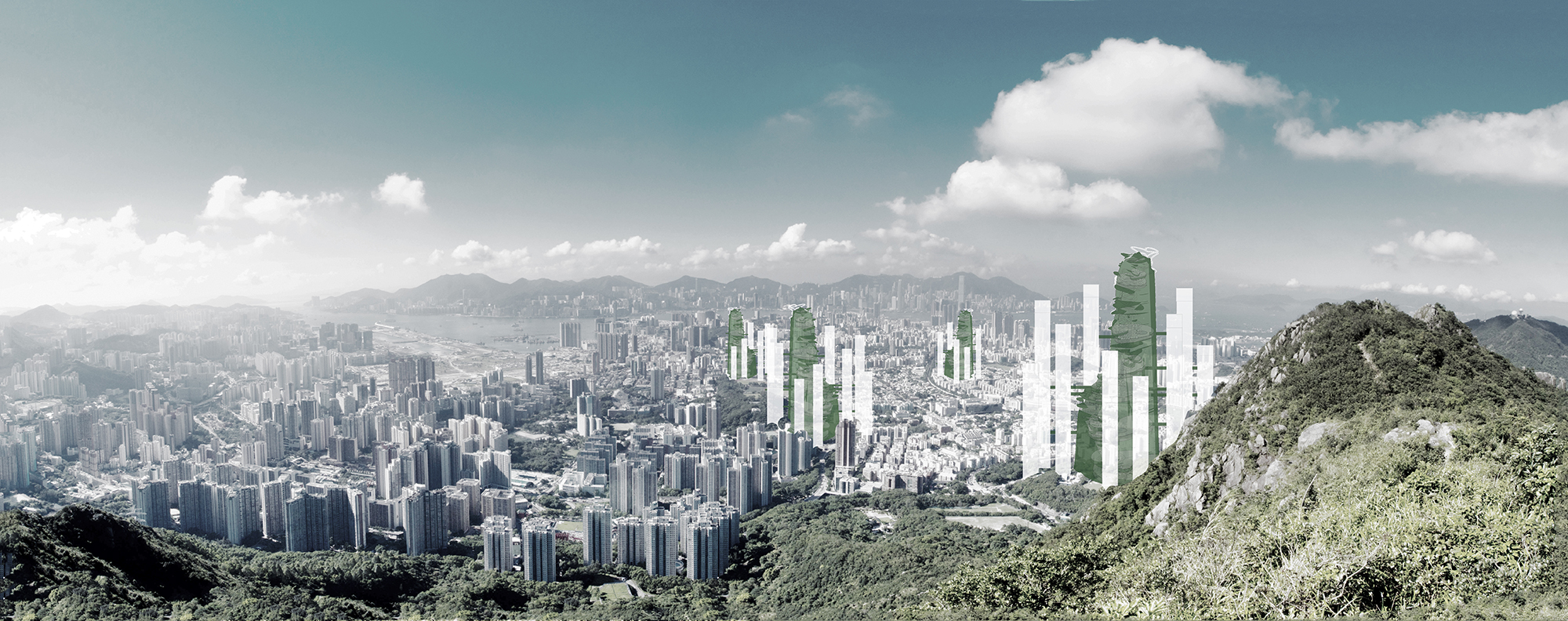
One example of this is the rending of a skyline. It is not uncommon to see the skyline of an American city like Los Angeles or Houston, collaged into the background of renderings for new projects in far-flung third and fourth tier provincial cities. In essence, true representation of context is not important when it comes to image making for these Chinese renderings. What matters is the appearance of urbanism: a fantasy which means dense clusters of tall buildings, even if those buildings come from somewhere else.

The theatrics do not stop with city skylines. Renderings for new commercial projects in China must give the appearance of affluence, even if the targeted demographic is not. Storefront signage must display luxury brand names like Gucci, even if those spaces will eventually be filled with dumpling restaurants. Photoshopped entourage must be abundant, even if it distracts from the architectural design. Palm trees and other non-native plant species are perfectly okay in renderings for projects in freezing northern Chinese cities and daytime skies are blue even if in reality pollution clouds the sky.

Architectural visualization specialists (and some architects for that matter) in China are not involved in design, but the marketing of urban fantasies to government officials.  Classic architectural principles like proportion, scale and how a building responds to context are forgotten matters in the race to build the future in China. The truth is there is no time to be so thoughtful.

MTR Island Line Extension Set to Change Hong Kong’s Western District

Blue Dot = Current Western Extent of MTR Hong Kong Island Line (Sheung Wan)       Red Dot = Terminus of Island Line Western Extension To Open in 2014 (Kennedy Town)

Infrastructure development continues in Hong Kong as the city’s Metro Transit Railway (MTR) extends its underground Island Line into the city’s Western District. Beginning construction in 2009, the western extension of the Island Line (dubbed the ‘West Island Line’) is set to open in 2014. The Island Line currently ends at Sheung Wan, one stop west of Central (Hong Kong’s central business district), but the extension will add three new stops, including Sai Ying Pun, Hong Kong University, and terminating at Kennedy Town.

MTR Station Under Construction On Pok Fu Lam Rd. Across from Hong Kong University

The West Island Line is unique because of uphill/downhill conditions at the Sai Ying Pun and Hong Kong University Stations. At both stations, MTR plans show station exits at various elevations, with high-speed vertical lifts transporting passengers from deep within the subway tunnel up to the Mid-Levels area (see this link for clear sectional diagrams of how this works). The Sai Ying Pun Staiton will have exits at three different elevations: Queen’s Road West, First St./Second St., and Bonham Road.

The extension will also be huge boon for students who commute to HKU. The university’s campus, situated on a steep hill and not easily accessible as a pedestrian, will be served by an exit directly across from the entrance at Pok Fu Lam Road.

The Island Line Western Extension Will Benefit Students Who Commute to HKU

The Belcher’s, a High-Rise Residential Development in the Western District

Because Hong Kong’s Western District is not well served by public transport, rents and property prices have traditionally been lower than other parts of the island with better access to the MTR. Aside from the Belcher’s, a high-rise residential development completed in 2001 that sits atop a shopping mall, the Western District still retains a marked ‘mom and pop’ low-key atmosphere.

It is hard to predict how this will change in 2014 when the West Island Line opens. Property developers  real estate investors have already taken note, but with most of the area already built up with an aging housing stock, there is not much new open space for development.

Whatever future changes come to the neighborhood though, the MTR extension is a positive development for Hong Kong as it continues to serve as  a model of public transportation efficiency for cities around the world.

Kennedy Town. MTR Construction in the Background