Category Archives: Nanjing

Lessard Design Wins Competition For Nanjing Technology Community

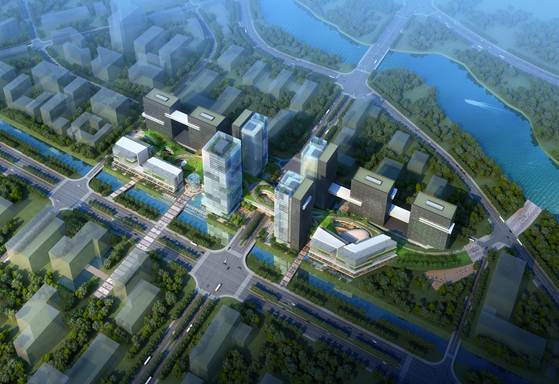
Lessard Design, an American architecture firm based out of the Washington D.C. area, recently shared with us some images of their competition winning entry for the Nanjing Technology Community. Designed in conjunction with local design institute Nanjing City-Town Architecture Design & Consultants (CTA Architects), the project is a 4,280,000 square foot office complex geared towards technology entrepreneurs.

The minimal, understated architecture of the office towers is a suitable backdrop to the generous amount of public space incorporated into the design. The complex features an elevated, active green space weaving through the central axis of the site. Other inviting public space includes a row of restaurant and retail spaces along the canal front.

Please see the following YouTube link for a very cool fly through animation of the project: Technology Core Community – Nanjing, China

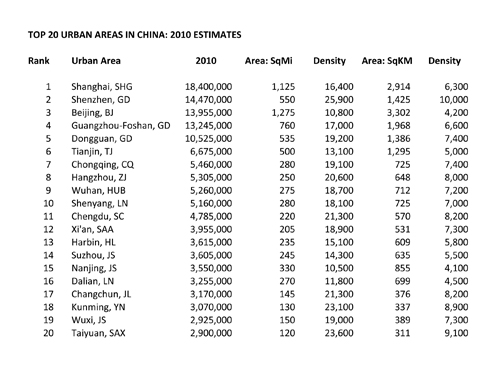
A Guide to China’s Rising Urban Areas

Source: Demographia World Urban Areas: Population & Projections: 6th Edition. http://demographia.com/db-worldua.pdf
 

I have a new piece up at NewGeography about China’s rising urban areas. Below is an excerpt from the introduction:

From a Rural to Urban Dispersion in the Middle Kingdom

China’s rise to economic prominence over the past 30 years has rested in large part to its rapid    urbanization. Prior to ‘reform and opening up’ that started in earnest during the 1970s, cities in China were viewed as pariahs by the party leadership. Millions of young urban dwellers were forced into the countryside to labor on farming communes during the Cultural Revolution. In stark contrast, today millions of rural migrants make their way to the city.

The scale at which this is happening is unprecedented. Currently, there are 85 metropolitan areas in China with more than 1 million people, compared to 51 in the US. By 2015, urban regions will account for half of China’s population and by 2025, the urban population’s share should reach about 75%.

To date, international attention has remained fixated on China’s largest cities of Beijing and Shanghai (and to a lesser extent, Guangzhou and Shenzhen). This is not without good reason, as Beijing and Shanghai are not only the respective government and financial centers of mainland China, but both were host to two of the most visible world events of the past decade: the 2008 Summer Olympics and the recently concluded World Expo.

Second and Third-Tier Cities Enter Onto the World Stage

Increasingly, however, the real trajectory of urban growth is shifting to China’s so-called ‘second-tier’ and ‘third-tier’ cities. To the outside observer, China’s lesser-known cities might seem all too similar to one another given the monotonous aesthetic of their newly constructed cityscapes. Indeed, the newfound appearance of Chinese cities is a point of contention among local urban development scholars who are concerned about the converging ‘identical faces’ of these urban areas.

Yet to Chinese locals and foreigners who have spent some time living here, it Chinese cities are defined more by their local cuisine, dialect, history, geography, culture and climate rather than their architectural character. These often-overlooked nuances of local culture are much more essential to the identity of these cities than buildings. In the future, these distinctions may prove more effective in attracting investment and talent than flashy new construction projects.

To continue reading about these cities please click here.

Beijing to Shanghai High-Speed Rail Opens

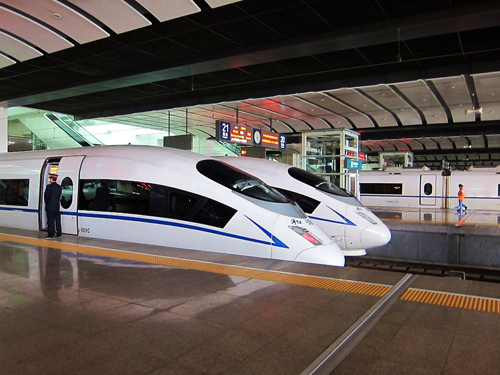
Photo by bennettdesign

China’s ambitious high-speed rail program inaugurated perhaps its most important line yesterday: Beijing to Shanghai. The train made its debut on the eve of the 90th anniversary of the founding of China’s Communist Party with Premier Wen Jiabao onboard declaring the line ‘in operation’.

The trip linking China’s two largest cities takes just under 5 hours and scheduled trains will make stops along the way in Tianjin, Jinan and Nanjing.

AFP Infographic

Linking China’s government/cultural center with its commercial/financial hub is a milestone on the path towards creating a connected nation. Airlines will certainly be hurt by the line, but because China’s air traffic is already at capacity, the train should help ease the strain on Beijing and Shanghai’s airports.

Freedom of choice when it comes to transportation options is paramount to social and economic mobility. Thanks to the multitude of options Chinese citizens will be afforded when traveling around the country, overall quality of life should be improve significantly.