Category Archives: Infrastructure

MTR Island Line Extension Set to Change Hong Kong’s Western District

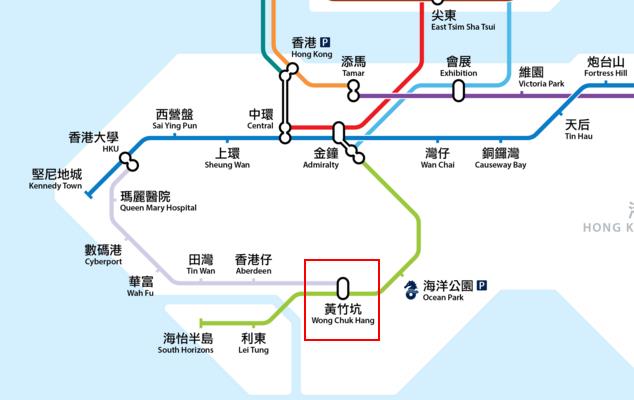
Blue Dot = Current Western Extent of MTR Hong Kong Island Line (Sheung Wan)       Red Dot = Terminus of Island Line Western Extension To Open in 2014 (Kennedy Town)

Infrastructure development continues in Hong Kong as the city’s Metro Transit Railway (MTR) extends its underground Island Line into the city’s Western District. Beginning construction in 2009, the western extension of the Island Line (dubbed the ‘West Island Line’) is set to open in 2014. The Island Line currently ends at Sheung Wan, one stop west of Central (Hong Kong’s central business district), but the extension will add three new stops, including Sai Ying Pun, Hong Kong University, and terminating at Kennedy Town.

MTR Station Under Construction On Pok Fu Lam Rd. Across from Hong Kong University

The West Island Line is unique because of uphill/downhill conditions at the Sai Ying Pun and Hong Kong University Stations. At both stations, MTR plans show station exits at various elevations, with high-speed vertical lifts transporting passengers from deep within the subway tunnel up to the Mid-Levels area (see this link for clear sectional diagrams of how this works). The Sai Ying Pun Staiton will have exits at three different elevations: Queen’s Road West, First St./Second St., and Bonham Road.

The extension will also be huge boon for students who commute to HKU. The university’s campus, situated on a steep hill and not easily accessible as a pedestrian, will be served by an exit directly across from the entrance at Pok Fu Lam Road.

The Island Line Western Extension Will Benefit Students Who Commute to HKU

The Belcher’s, a High-Rise Residential Development in the Western District

Because Hong Kong’s Western District is not well served by public transport, rents and property prices have traditionally been lower than other parts of the island with better access to the MTR. Aside from the Belcher’s, a high-rise residential development completed in 2001 that sits atop a shopping mall, the Western District still retains a marked ‘mom and pop’ low-key atmosphere.

It is hard to predict how this will change in 2014 when the West Island Line opens. Property developers  real estate investors have already taken note, but with most of the area already built up with an aging housing stock, there is not much new open space for development.

Whatever future changes come to the neighborhood though, the MTR extension is a positive development for Hong Kong as it continues to serve as  a model of public transportation efficiency for cities around the world.

Kennedy Town. MTR Construction in the Background

24 City Rises in Southeast Chengdu

The sound of new development roars all over Chengdu. One area that is particularly on the uptick is the southeast, just outside the 2nd Ring Road. Not long ago a heavy industrial zone, several former factory sites were cleared to make way for new high-density residential, retail and office development.

Today the area is a gigantic series of noisy, dusty construction sites. Not only is abundant new real estate floor space being built, but the area is making way for two upcoming metro lines: line 2 and line 4. Though only 4.5 km from the city center, the area feels worlds away from the city’s historic core. Yet as Chengdu continues to sprawl out, the new development is bound to become part of the urban area within a few years.

24 City is 4.5 km south-east of Chengdu’s city center (highlighted in purple)

One of the large new developments in this area is 24 City, spanning several blocks with a new shopping mall, office and residential towers. The shopping mall and office tower are designed by American architecture firm Callison and is rounding out construction.

Callison-designed terraced shopping mall

A new office tower rises out of the shopping mall podium

The retail podium topped out with office tower is the standard formula for commercial mixed-use developments across Chengdu (and China). The almost complete buildings are only Phase I, which is planned to be followed by several more phases of retail podium + towers on top.

Across the street from the shopping mall are two new residential compounds with clusters of dozens of tall buildings. A quick peek into one of the sales centers confirmed that the new units have no problem being sold off. Whether intended as speculative investments or primary residences, the investments are bound to payoff as the proximity to the planned subway stops means that this will soon be a convenient area for moving around the city by public transit.

Unfortunately the design of the residential compounds leave much to be desired. On one side, a row of regimented towers lines the adjacent public street, creating an ominous canyon of darkness. The inside of the compound is a much more pleasant environment, with well-kept landscaped grounds punctuated with water features.

Tragically, these areas of respite lay behind electric fences and are for residents only. So, despite giving off the image of ‘real’ urbanism (dense clusters of high-rise towers), theses developments are no different from the gated communities of sprawling American suburbia. In the end, 24 City is unremarkable in that it follows the same pattern of brand-new development being followed in countless other Chinese cities without breaking any new ground.

Guangzhou’s New Central Business District: Zhujiang New Town

Guangzhou’s New CBD (highlighted in red) sits north of the Pearl River and east of the Old City in what not long ago was agricultural land

Recently I visited Zhujiang New Town, Guangzhou’s newly built central business district (CBD). While Guangzhou itself is hardly a new city (its status as an international trading port goes back centuries), the CBD is brand new, built on what used to be agricultural land well outside of the historic city core. Though thanks to the city’s expanding underground metro and freeway system, Zhujiang New Town doesn’t seem so far away.

Currently Zhujiang New Town is best known as the site for the Guangzhou Opera House and many of the athletic venues for the 2010 Asian Games. One unique aspect about Guangzhou’s CBD compared with others around China is its marriage of cultural buildings with commercial office towers. In this regard, Zhujiang New Town is not much different from the planned ‘downtowns’ of sprawling 20th Century American cities like Los Angeles, Phoenix and Houston.

The iconic Canton Tower sits across the river, just south of the new CBD

View looking north at towers going up in the CBD

Aerial map of Guangzhou CBD

Adjacent to the Pearl River to the north is the site of Zhujiang New Town’s new cultural venues linked by a paved plaza. Directly north of that begins a park stretching four long blocks lined with brand new office towers. Underneath the park, a metro line runs the length of the CBD. This particular line of the Guangzhou metro system has no driver (so far this is the only instance of this I’ve seen in China!).

While the cultural venues were bustling with life when I was there, many of the completed office buildings were for the most part unoccupied and the park was a no-man’s land. This is not to say that the towers won’t be occupied very soon, as the finishing touches were just being put on. It will be interesting to see how this sparkling new CBD fills itself up in the coming months and years ahead.

1. Guangzhou Opera House

2. Guangdong Museum

3. Guangzhou Library

4. IFC Tower

5. New Commercial Office Buildings

6. Agricultural Bank of China Building

7. The Pearl River Tower

8. More Commercial Office Towers Under Construction

Deindustrializing Beijing: Images from the Decommissioned China National Steel Factory

Beijing’s poor air quality is a well-documented phenomenon, yet what is often not considered is the fact is that the municipality has taken steps in recent years to deindustrialize and move its polluting factories outside the city to neighboring provinces (mainly Hebei Province). Unfortunately the closure of factories doesn’t seem to have done much to abate Beijing’s air quality problems as an increasing number of private automobiles continue to clog the city’s roads. That being said, Beijing did try its best to at least keep its air clean for the two weeks of the Summer Olympics back in 2008.

One of the most high-profile examples of this effort was the permanent closure of the China National Steel Factory in western Beijing- one of the largest steel mills in the country. My friend and Beijing resident Daniel Garst, an American writer, recently had the opportunity to visit the decommissioned factory and take some nice shots of the slowly decaying complex.

As the future remains uncertain for the former steel factory, it presently serves as a reminder of Beijing’s industrial past and is a prime location for shooting photography and filming commercials. Perhaps the factory will be reused in the future as a commercial/entertainment district as developers take advantage of the ‘industrial chic’ aesthetic to redevelop other decommissioned factories around the country.

For now, please enjoy the following images of the abandoned complex.