Category Archives: Hong Kong

Illuminating Hong Kong’s Bank of China Tower

BankOfChina_LightingHong Kong’s Bank of China building with its original nighttime lighting scheme (left) compared to its current one (right)

The following post was written by John Yuan, a Chinese-American architect who worked on the design of the Bank of China building in Hong Kong during his tenure as an employee of I.M. Pei’s architectural practice:

Since first returning to visit Hong Kong around the time of the handover to China in 1997, I noticed that Bank of China Tower appeared strikingly different at night during subsequent visits over the next decade. I never imagined that the exterior lighting scheme for the tower would ever be altered from the original design done by Fisher Marantz, the lighting consultant to I.M. Pei’s office on the project.

Even from the beginning of the design process, illuminating the tower at night posed great challenges. The tower stands over 300 meters tall and has an exterior covered mostly in reflective glass- characteristics which both posed difficulties for the nighttime lighting design.

By carefully aiming spotlights from the ground up at the tower, Marantz managed to evenly illuminate the soaring tower from top to bottom. The vast area of the dark window panes, sprinkled with lights from the interior spaces and bounded by the illuminated aluminum panels at the corners, created a compelling image. The tower seemed almost transparent outlined by the illuminated borders– a proud structural skeleton standing in the Hong Kong skyline.

I first grasped the death of the original exterior lighting design during a visit in 2006. Arriving in the evening and riding in a cab on my way to a Mid-Levels hotel, I passed by the tower but I couldn’t see it, except for its pencil-thin but brightly lit outline. Strips of LED had been inserted into the originally unlit feature line dark grey aluminum panels. The LED, set at such high intensity, rendered the interior office lighting feeble by comparison.

In my very last visit, the tower illumination further deteriorated from what Bank of China, a Class A office tower, deserves. The LED remain but are now programmed to light up in sequence as if the building is being sketched out in the night sky. The tower might as well be an animated pillar in an amusement park.

Despite the changing illumination schemes, the nighttime view of Bank of China never conveyed what the tower does during the day. Pei referred to the structural cross bracing as ‘diamonds’ (after the client reacted negatively to the ‘X’ shape of the bracing), but the real diamond quality actually comes from the refraction of natural light on the tower’s geometrically accentuated massing during the day.

Lighting the tower at night, even with the original illumination scheme, did not do justice to the unique form of the building. The outlined LED lighting exacerbated the problem further by making the well proportioned edge panels disappear. Unfortunately, the result is a tower lacking presence with the building volume flattened into the night.

MTR Island Line Extension Set to Change Hong Kong’s Western District

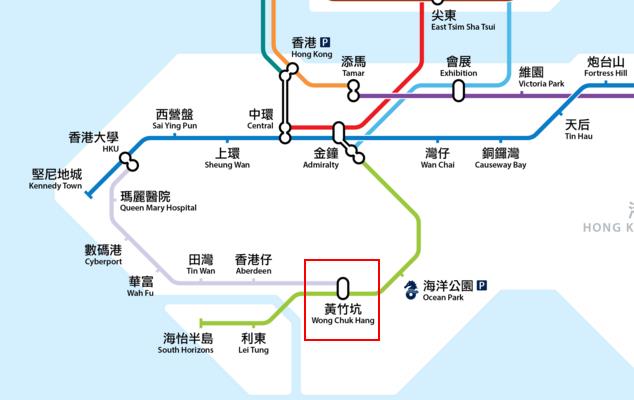
Blue Dot = Current Western Extent of MTR Hong Kong Island Line (Sheung Wan)       Red Dot = Terminus of Island Line Western Extension To Open in 2014 (Kennedy Town)

Infrastructure development continues in Hong Kong as the city’s Metro Transit Railway (MTR) extends its underground Island Line into the city’s Western District. Beginning construction in 2009, the western extension of the Island Line (dubbed the ‘West Island Line’) is set to open in 2014. The Island Line currently ends at Sheung Wan, one stop west of Central (Hong Kong’s central business district), but the extension will add three new stops, including Sai Ying Pun, Hong Kong University, and terminating at Kennedy Town.

MTR Station Under Construction On Pok Fu Lam Rd. Across from Hong Kong University

The West Island Line is unique because of uphill/downhill conditions at the Sai Ying Pun and Hong Kong University Stations. At both stations, MTR plans show station exits at various elevations, with high-speed vertical lifts transporting passengers from deep within the subway tunnel up to the Mid-Levels area (see this link for clear sectional diagrams of how this works). The Sai Ying Pun Staiton will have exits at three different elevations: Queen’s Road West, First St./Second St., and Bonham Road.

The extension will also be huge boon for students who commute to HKU. The university’s campus, situated on a steep hill and not easily accessible as a pedestrian, will be served by an exit directly across from the entrance at Pok Fu Lam Road.

The Island Line Western Extension Will Benefit Students Who Commute to HKU

The Belcher’s, a High-Rise Residential Development in the Western District

Because Hong Kong’s Western District is not well served by public transport, rents and property prices have traditionally been lower than other parts of the island with better access to the MTR. Aside from the Belcher’s, a high-rise residential development completed in 2001 that sits atop a shopping mall, the Western District still retains a marked ‘mom and pop’ low-key atmosphere.

It is hard to predict how this will change in 2014 when the West Island Line opens. Property developers  real estate investors have already taken note, but with most of the area already built up with an aging housing stock, there is not much new open space for development.

Whatever future changes come to the neighborhood though, the MTR extension is a positive development for Hong Kong as it continues to serve as  a model of public transportation efficiency for cities around the world.

Kennedy Town. MTR Construction in the Background

9/11, China and the Enduring Symbolic Power of the Skyscraper

1 World Trade Center Rising in Lower Manhattan

Now that it has been about a month since the 10 year anniversary of the 9/11 attacks in the U.S., I have had some time to reflect on the enduring significance of the skyscraper. With One World Trade Center finally starting to form a new image in the Manhattan skyline, we see that in spite of protestations to building such a tower on sacred ground, construction crews move ahead to realize what will perhaps be the city’s most ambitious project in years. Some question why it has taken so long to get to this point while others still see the entire rebuilding effort as an affront to the memory of tragedy.

It really seems not long ago at all- I was barely into my third week of architecture school at the University of Southern California when terrorist attacks brought down the Twin Towers. Despite living in America’s second largest city at the time, it was difficult to fathom the horror that was taking place across the country in New York. Like everyone else around the world, my classmates and I watched the television in shock as we tried to process what was happening.

In the days and weeks that followed, I expected there to be some discussion in my classes about the symbolic power of architecture- more specifically an in-depth analysis as to why the World Trade Center was the target of such an attack. Surprisingly, my instructors were reluctant to talk about this topic and instead centered most of the discussions around debating the technical details about how the buildings failed.

Looking back, it is clear why Al-Qaeda chose the World Trade Center and the Pentagon, America’s respective symbols of commercial and military strength, as targets for attack. Yet why did my architecture professors fail to acknowledge this at the time?

For the younger instructors, I suspect the modernist paradigm had already ceased to be relevant since architectural historian Charles Jencks declared the death of modern architecture when Pruitt-Igoe, a failed public housing project in St. Louis designed by Minoru Yamasaki (who also designed the ill-fated World Trade Center), was imploded in 1972. For this generation of architects who were educated in the 1980′s and 90′s, it was the tongue-in-cheek classicism of post-modernism and the cynical musings of deconstructivists like Peter Eisenman and Bernard Tschumi who influenced their outlook. To them, I presume, the World Trade Center was already a dinosaur from another era long before the attacks that brought the towers down.

For the older generation of tenured professors, to question why the World Trade Center was the target of terrorist attacks was to question the entire legitimacy of the modernist project in the U.S.A. These are individuals whose careers fortuitously coincided with the golden age of American prosperity during the 1950′s, 60′s and 70′s. In retrospect, perhaps it was out of a sense of respect to the modernist paradigm in which they believed and spent their careers teaching aspiring architects that they not publicly question the ‘why’ of 9/11.

It was not until my first full-time job after graduating in the summer of 2006 that I fully grasped the symbolic power of architecture, specifically the skyscraper building type. I worked for an architect by the name of Richard Keating, who spent most of his career in the 1970′s and 80′s as a partner at Skidmore, Owings and Merrill (SOM), the gold standard in American corporate high-rise design. While at SOM, Keating designed several of the commercial office towers that define the skylines of cities like Houston, Dallas, and Los Angeles.

While many architects and commentators declared the end of the tall building type after 9/11, Keating was not among them. On the contrary, he understood the enduring appeal of skyscrapers not only to property developers and government officials, but also to the common man as an aspirational device.

Coincidentally, the first project I worked on in Keating’s office was a lobby renovation for Minoru Yamasaki’s other twin towers- the triangulated Century Plaza Towers in the Century City section of Los Angeles- originally built in 1975. Rather than let the modernist icon be relegated to the dust bin of history, we were tasked with updating the project’s public spaces with a 21st Century twist.

The Century Plaza Towers are a pair of classic high-rise towers of their era: pure rational forms in plan, extruded up 44-stories towards the sky

Building tall is somewhat formulaic as the considerations of natural forces such as gravity, wind, severe weather and potential seismic activity are always taken into great account when designing high-rise buildings anywhere in the world. Being as such, skyscrapers are just as much feats of engineering as they are architecture. In fact, some of the most recognizable skyscrapers make use of structure as the central focus of their architectural expression. One only needs to think of the cross-bracing structures of the Hancock Tower in Chicago or Bank of China building in Hong Kong to be reminded of this.

Bank of China building in Hong Kong by I.M Pei

Today the trend in high-rise design is not structural, but formal expression. Rather than being exposed for all to see, structure is now most often hidden behind shimmering glass curtain-walls while the towers twist and  torque upwards. Thanks to computer programs that allow architects to explore unconventional forms, skyscrapers need not be strictly Cartesian in nature.

“Absolute Towers” by Beijing-based MAD Architects in Mississauga, Canada

The ongoing economic crises in Europe and the U.S. put a dent into the skyscraper building program in the Western world. This is not the case in developing nations, especially China, where towers are rising in myriad cities across the country. When it comes to building the high-profile ‘supertall’ towers (buildings over 300 meter tall), Chinese clients still prefer to outsource the design to the experts with a track record in high-rise design, namely American firms like SOM, KPF, and Smith+Gill.

Yet these marquee projects do not account for nearly the thousands of other tall buildings over 100 meters being built in China, both in central business districts and outlying suburban areas. Most of these towers are nondescript and serve the straightforward purpose of housing an increasingly urbanized population. Perhaps bland on an individual level, collectively the high-rises that define rising skylines in Chinese cities represent the aspirations of an upwardly mobile population.

The Chongqing skyline, quickly becoming one of the most recognizable in the world

Cynics would argue that high-rise buildings in reality represent nothing more than real estate developer greed, benefiting few while exploiting the working class for cheap construction labor. While criticisms have their merit, the overwhelming consensus in China is in favor of a modernization program that includes the construction of tall buildings.

Not long ago I was walking down the new ‘financial street’ in Chengdu near my home where several new high-rise buildings between 150 and 200 meters tall are currently under construction. I noticed a beat-up car with license plates from a small Sichuan Provincial town stopped at a red light. Inside the car was a family of two parents and a child, looking up in awe at the glistening new skyline.

I knew at that moment that it didn’t matter if they never set foot inside those new buildings…what the towers represent was enough to inspire a sense of awestruck wonder in this family. And while American economists continue to bash China’s urbanization process, calling this the ‘biggest real estate bubble ever’, they tend to forget that it was in America that the skyscraper was invented and perfected. There is a certain universality of a desire to reach for the heavens, and China’s urban areas are the best reminders of that today.

Land Reclamation and the Future of Hong Kong

Land reclamation is a controversial approach to urban planning wherever water-bound cities are land-strapped for new development. In the U.S., a place like San Francisco is a prime example of a city where much of the adjacent waterfront was ‘reclaimed’ from the bay and land-filled to make room for new buildings.

In Asia, Hong Kong practices land reclamation to accommodate large structures such as its convention center and Chep Lap Kok Airport. A piece from Metropolis magazine takes a closer look at reclamation and urban renewal in Hong Kong and how it is impacting its most prized asset: Victoria Harbor.

Metropolis: From Reclamation to Renewal

Foster + Partners Wins Hong Kong’s West Kowloon Cultural District Master Plan Competition

Although famous as an international trading and banking center, Hong Kong, save for a strong culinary tradition, lacks in the culture department. The city is just simply not know as an arts destination. That reputation could be changing soon as southwest tip of Kowloon is redeveloped into a large cultural district.

The West Kowloon Cultural District seeks to fill the void of a lacking arts scene in the Special Administrative Region. While undertakings by city governments around the world looking to create large-scale arts or culture districts sometimes come off as desperate attempts to prevent decline and irrelevance, Hong Kong has not such problem of reverting to a backwater anytime soon.

Yet one has to wonder if this is not an attempt by the SAR to distinguish itself as a more refined cultural destination than its Mainland China first-tier city counterparts.

If anything, the West Kowloon Cultural District PR department has done a good job so far of generating international interest with a highly publicized competition for the master plan of the project. World renowned British architecture firm Foster + Partners was recently selected as the winner. Foster + Partners beat out proposals from Rocco Design Architects Limited and OMA/Rem Koolhaas.

Foster + Partners is no stranger to Hong Kong, having been behind the design of the iconic HSBC Building and the city’s masterful Chek Lap Kok Airport. The firm’s concept for the West Kowloon master plan is guided by a desire to create a ‘City Park‘ filled with greenery. Proposed buildings include an Expo Center, Opera House, Chinese Theater, Art School, Theater School, Modern Art Museum, and Concert Hall. Although the buildings for the project are yet to be designed, Foster’s master plan scheme promotes the idea of a minimally refined unifying architectural aesthetic.

The China Urban Development Blog will keep an eye on the ongoing developments for this potentially game-changing project for Hong Kong.

Bustler: Foster + Partners Selected to Design Master Plan for West Kowloon Cultural District, Hong Kong